GMRS vs Ham Radio: Which One Actually Fits Your Needs?
If you’ve started shopping for a two-way radio, you’ve probably run into two acronyms that keep showing up next to each other: GMRS and Ham Radio. They look similar on the shelf. Both are handheld radios with antennas, both need a license, and both promise “miles of range” on the box. But they’re built for genuinely different jobs.
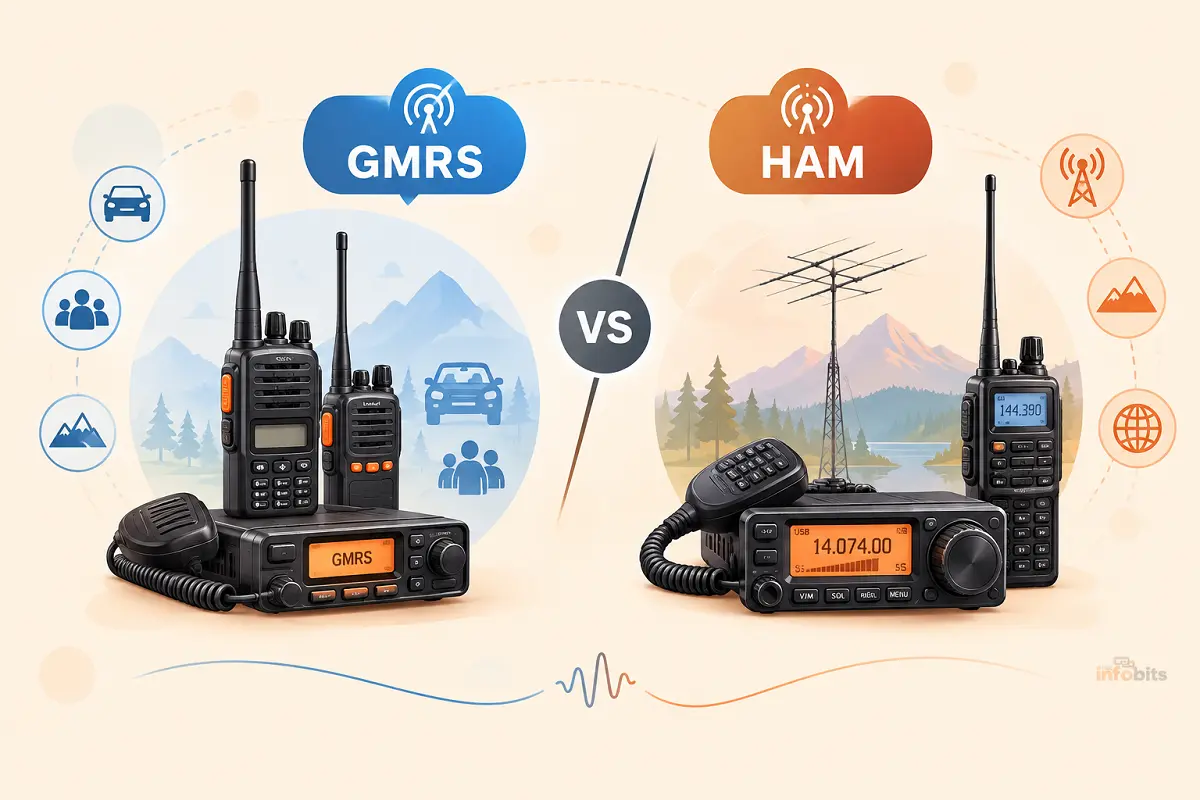
GMRS (General Mobile Radio Service) is the simple, family-friendly option: pay a fee, skip the test, and start talking on a fixed set of channels shared with everyone else on GMRS.
Ham radio (amateur radio) is the deeper hobby: pass an FCC exam, get your own call sign, and gain access to a huge range of frequencies, modes, and capabilities, including worldwide communication with the right setup.
Neither one is “better” outright. The right choice depends on who’s using it and why. Here’s everything you need to decide.
Quick Answer:
- GMRS: $35 FCC license, no exam, covers your entire immediate family, up to 50 watts, UHF band only, best for families, off-roading groups, and simple local communication.
- Ham Radio: Free FCC license (a ~$15 exam fee applies), one license per person, access to many bands including HF for long-distance and even worldwide contacts, best for hobbyists, preppers who want depth, and anyone who wants to actually learn radio.
- They aren’t interchangeable. A GMRS radio can’t legally transmit on ham frequencies, and a ham radio operating on GMRS channels needs a GMRS license too. They’re separate FCC services with separate rules.
If you want the fastest path to “radios that work between family members,” start with GMRS. If you want a genuine technical hobby with the widest possible range of capability, ham radio is worth the extra effort.
What Is GMRS?
GMRS is a licensed, family-oriented radio service regulated by the FCC, operating entirely in the UHF band around 462–467 MHz.
It was originally designed for short-range personal and business communication, and today it’s most commonly used by families, off-road and overlanding groups, and preppers who want more range and power than the license-free FRS (Family Radio Service) radios sold at most big-box stores.
Key things that define GMRS:
- One license, whole family covered. A single $35 GMRS license covers you and your immediate family ( spouse, kids, parents, siblings, and in-laws) for 10 years, with no exam required.
- Up to 50 watts on the top channels. GMRS shares its first 22 channels with FRS, but GMRS radios are allowed to transmit at much higher power on most of them, plus GMRS gets exclusive access to eight repeater-input channels.
- Repeater access. Many areas have community GMRS repeaters that extend range dramatically, often to tens of miles instead of the one-to-two miles typical of handheld-to-handheld range.
- No technical exam. You pay the fee, submit an online application through the FCC’s licensing system, and you’re generally authorized within minutes.
What Is Ham Radio?
Ham radio, formally “Amateur Radio,” is a much broader hobby and licensed service that gives operators access to dozens of frequency bands across VHF, UHF, and HF (high frequency), the last of which can support communication across entire continents and oceans depending on conditions and equipment.
Key things that define ham radio:
- Licensed to the individual, not the family. Every operator who wants to transmit needs their own license and call sign. There’s no family coverage the way GMRS offers.
- A real, if approachable, exam. The entry-level Technician license requires passing a 35-question multiple-choice exam covering basic regulations, safety, and operating practices. Morse code is no longer required at any license class.
- Three license tiers. Technician (entry-level, most VHF/UHF privileges plus limited HF), General (opens up most HF bands and long-distance communication), and Amateur Extra (the full spectrum of ham privileges).
- Free FCC license, small exam fee. The FCC license itself is free, but Volunteer Examiner (VE) testing sessions typically charge around $15 to sit the exam.
- A genuine technical community. Ham radio includes everything from casual local chats on a repeater to emergency communications volunteering, satellite communication, digital modes, and DXing (making contact with distant stations worldwide).
Related: Ham Radio vs CB Radio (and GMRS): Which One Should You Get?
GMRS vs Ham Radio: Side-by-Side
| GMRS | Ham Radio | |
|---|---|---|
| License cost | $35 (10-year term) | Free license; ~$15 exam fee |
| Exam required? | No | Yes (Technician exam to start) |
| Who’s covered | Licensee + immediate family | One person per license |
| Frequency bands | UHF only (462–467 MHz) | Multiple bands: VHF, UHF, HF (with higher license classes) |
| Max power (handheld/mobile) | 50 watts (top channels) | Up to 1,500 watts (Extra class, HF) |
| Typical range (handheld) | 1–2 miles, more with repeaters | Similar locally; global with the right HF setup |
| Repeater access | Yes, GMRS-specific repeaters | Yes, much larger repeater network |
| Best for | Families, off-roading, simple local comms | Hobbyists, emergency-comms depth, long-distance |
| Call sign | One per license (covers family) | Unique per operator |
Can a Ham Radio Talk to a GMRS Radio?
This is one of the most common points of confusion, so it’s worth being direct: generally, no.
GMRS and ham radio are separate FCC-regulated services with separate rules, and a radio (or operator) licensed for one service can’t legally transmit on the other’s frequencies without the matching license.
There is a narrow overlap on the 70 cm ham band that technically shares some frequency space with GMRS, but casually cross-communicating between the two services isn’t something most users should rely on. It requires specific licensing and equipment considerations that go beyond what a typical handheld setup supports.
If your goal is a mixed household- some members who want to keep it simple, others who want to go deeper into the hobby – the practical answer is usually to run GMRS radios for the family and let the ham-licensed member(s) operate separately on ham frequencies, rather than trying to blend the two services on one device.
Which One Should You Choose?
Choose GMRS if:
- You want radios that work for the whole family without each person taking a test
- Your use case is local: camping, off-roading, hiking groups, neighborhood or property communication
- You want to be on the air within the hour, not after weeks of studying
- You’re comfortable with radios other GMRS users nearby are also using
Choose Ham Radio if:
- You want to actually understand how radio works, not just use it
- You’re interested in emergency communications volunteering (ARES/RACES) at a deeper level
- You want access to HF bands for genuinely long-distance or even global communication
- You don’t mind studying for an exam and want the credibility and depth of a technical license
Related: What Is Ham Radio Used For? 12 Real Uses
Consider both if:
- You’re building a serious off-grid or emergency-preparedness communication plan. Many experienced preppers and off-roaders run GMRS for simple family coordination and hold a ham license for the deeper backup capability, since the two services complement each other rather than compete.
Common Mistakes to Avoid
- Assuming GMRS and FRS are the same thing. FRS radios are license-free but capped at low power. GMRS shares some channels with FRS but requires a license for higher power and repeater access. Check your radio’s actual output before assuming you’re covered.
- Skipping the license because “everyone does it.” Unlicensed GMRS or ham transmission is technically illegal and can result in FCC fines, even though enforcement is inconsistent.
- Buying a “GMRS/ham” combo radio without understanding the legal limits. Some radios are marketed as covering multiple services, but that doesn’t mean it’s legal to transmit on every band without the matching license for each one.
- Overestimating handheld range. Manufacturer range claims (sometimes “up to 30+ miles”) reflect ideal, obstruction-free conditions. Real-world handheld-to-handheld range in hilly or wooded terrain is usually much closer to 1–2 miles without a repeater.
- Forgetting repeaters need their own setup. Both GMRS and ham repeater access typically require programming the correct input/output frequency pair and tone codes. It’s not automatic just because you’re in range.
Myth vs Fact
Myth: “Ham radio is only for older hobbyists with technical backgrounds.” Fact: The Technician exam is genuinely approachable with a weekend or two of study, and there’s no age minimum. Many licensed operators are teenagers or complete beginners to electronics.
Myth: “GMRS doesn’t need a license if I’m just using it for family camping trips.” Fact: Any GMRS radio transmitting above FRS power limits legally requires the $35 GMRS license, regardless of how casual the use is.
Myth: “A more expensive radio automatically gets better range.” Fact: Range depends far more on terrain, antenna height, and repeater access than on the radio’s price tag. A modest radio using a repeater will usually outperform an expensive handheld using simplex (radio-to-radio) in hilly terrain.
Myth: “You need Morse code for a ham license.” Fact: Morse code testing was dropped from all U.S. amateur radio license classes years ago. It’s optional to learn, not required.
Setting Up: A Simple Checklist
- Decide your primary use case: family/local coordination points toward GMRS; hobby depth and long-range capability points toward ham.
- For GMRS: create an FCC account (FRN), apply for a GMRS license (application code “ZA”), and pay the $35 fee. Approval is often near-instant.
- For Ham Radio: find a local Volunteer Examiner (VE) testing session, study for the Technician exam (many free practice-question apps and courses exist), and sit the ~$15 test.
- Buy radios that match your license, checking that any “GMRS” or “ham” labeling is accurate to your actual license class.
- Program your radios with the correct local repeater frequencies and tone codes if you plan to use repeaters.
- Practice basic radio etiquette. Identify with your call sign periodically, keep transmissions brief, and avoid interfering with others on shared channels.
- If going deeper into ham radio, consider studying for the General license next to unlock most HF bands and real long-distance capability.
Expert Tips
- If your household has mixed needs, a common and effective setup is a set of GMRS handhelds like the Midland GXT series for family coordination (available on Amazon), paired with a dedicated ham radio for the household member who wants deeper capability.
- For anyone serious about off-grid or emergency communication, a dual-band ham handheld such as a BTECH or Yaesu model (both are available on Amazon) gives access to both the 2m and 70cm bands, covering the most commonly used local repeater frequencies.
- Range on both services benefits enormously from a higher-mounted external antenna rather than a stock rubber-duck handheld antenna. Often a bigger upgrade than buying a more expensive radio outright.
- If you’re studying for the Technician exam, a dedicated study guide (get from Amazon) or practice-exam app can cut prep time down to a weekend for most people, since the question pool is publicly published in advance.
Related: Best Ham Radio for Beginners: 8 Top Picks with Buying Guide
Conclusion
GMRS and ham radio solve different problems, even though they look similar sitting side by side on a store shelf.
GMRS gets your whole family on the air quickly, with one license and no exam, which is ideal for camping, off-roading, and everyday local coordination.
Ham radio asks more of you upfront – an exam, an individual license. But rewards that effort with real technical depth and the possibility of genuinely long-distance communication.
For most families, the practical starting point is GMRS. For anyone who wants radio as an actual hobby, or who’s building a serious emergency-communications plan, studying for a ham radio Technician license is a worthwhile next step, and the two services work well together rather than against each other.
Frequently Asked Questions
What’s the main difference between GMRS and ham radio?
GMRS is a simpler, license-required (but exam-free) service covering an entire family on UHF frequencies. Ham radio requires passing an exam, licenses only the individual operator, and grants access to many more bands, including HF for long-distance communication.
Do I need a license to use a GMRS radio?
Yes, if the radio transmits above FRS power limits (generally more than 2 watts on shared channels, or on any GMRS-exclusive channel). The license costs $35 and lasts 10 years.
Do I need to pass a test to get a GMRS license?
No. GMRS has no exam. You apply online through the FCC and pay the fee.
Do I need to pass a test to get a ham radio license?
Yes. The entry-level Technician license requires passing a 35-question multiple-choice exam on basic radio theory, safety, and regulations.
Does a GMRS license cover my whole family?
Yes. One GMRS license covers the license holder and their immediate family, including spouse, children, parents, siblings, and in-laws.
Does a ham radio license cover my whole family?
No. Each individual who wants to transmit on ham frequencies needs their own separate license and call sign.
Can a GMRS radio talk to a ham radio?
Generally no. GMRS and ham radio are separate FCC services with separate frequency allocations and rules, and cross-communication isn’t something typical handheld setups are built for.
How much does a ham radio license cost?
The FCC license itself is free, but Volunteer Examiner testing sessions typically charge around $15 to sit the exam.
How much does a GMRS license cost?
$35 for a 10-year term, with no per-radio or per-family-member fee.
What’s the real-world range of a GMRS radio?
Handheld-to-handheld range is typically 1–2 miles in realistic terrain, though repeater access can extend effective range to tens of miles in areas with GMRS repeater coverage.
What’s the real-world range of a ham radio?
Local VHF/UHF range is similar to GMRS, roughly a few miles handheld-to-handheld, but HF bands (available with a General or Extra license) can support communication across hundreds or thousands of miles depending on conditions and equipment.
Is ham radio harder to learn than GMRS?
There’s more to learn, since ham radio involves an exam and covers a much wider technical scope, but the entry-level Technician exam is considered approachable for most people with modest study time.
Can I use GMRS radios for business use?
GMRS was originally designed with some business use in mind, but today it’s licensed for personal and family use; commercial operations typically fall under different FCC services such as Part 90 business radio.
Are FRS and GMRS radios the same?
No. FRS (Family Radio Service) is license-free but limited to lower power. GMRS shares some channels with FRS but allows significantly higher power on most channels and requires a license.
Can I use GMRS or ham radio internationally?
Rules vary significantly by country. In Canada, for example, ham radio licenses have a reciprocal agreement with the U.S., but GMRS licenses don’t carry the same legal standing. Always check the destination country’s specific rules before transmitting.
What license class should a beginner get for ham radio?
The Technician license is the standard entry point, granting most VHF/UHF privileges and some limited HF access, and is the prerequisite for testing toward General and Amateur Extra.
Is GMRS good for emergency preparedness?
It’s a solid option for family-level coordination, especially with repeater access, but it has less range flexibility and technical depth than ham radio for serious grid-down emergency communication planning.
Do I need a callsign for GMRS?
Yes, though GMRS call signs are simpler. One call sign per license, used by the licensee and covered family members.
Can children use GMRS or ham radio?
Yes to both. GMRS coverage extends to family members under the primary license, and there’s no minimum age requirement for a ham radio license, provided the individual can pass the exam.
Is it legal to use a GMRS radio without a license if I’m just listening?
Yes. Listening (receiving) doesn’t require a license under either GMRS or ham radio rules. A license is only required to transmit.
Found this guide useful? Share it with someone who is suffering from networking-related issues. Follow us on Facebook and Twitter for more tips, tricks, and guides.
We also ask that you bookmark this page for future reference, as we are constantly updating our articles with new information.
Sign up for our free newsletter as well to receive fresh information immediately in your inbox and keep technically up to date.
Disclosure: If you follow our links to a retailer’s website and make a purchase, we will get an affiliate commission on some, but not all, of the items or services we promote. This will cause no price change for you.