Best Ham Radio for Beginners in 2026: 8 Top Picks with Buying Guide
Getting into ham radio is one of the few hobbies left where a $25 device can genuinely let you talk to someone across town, across the country, or, with the right setup, across the world, with no internet or cell tower involved.
But walk into the beginner section of any ham radio retailer, and you’ll hit a wall of nearly identical black handhelds, confusing frequency specs, and forum arguments about which brand is “real” ham gear.
It’s overwhelming, and picking the wrong first radio is a common reason people lose interest before they even get licensed.
This guide cuts through that. Below are our current top picks for beginners in 2026 across every budget and use case, an honest look at the Baofeng legality question that trips up a lot of new hams, and a full buying guide covering everything from frequency bands to your first antenna.
Quick note before we start: in the US, you need an amateur radio license from the FCC to legally transmit on ham frequencies. Anyone can buy a radio, but you’ll need to pass a simple exam first. More on that below, or jump straight to our ham radio license guide.
Quick Picks: Best Ham Radios for Beginners
Best Overall: BAOFENG BF-F8HP PRO 10W
Best Value Classic: BAOFENG BF-F8HP
Best Budget Pick: BAOFENG UV-5R 8W
Best Budget Tri-Band: BAOFENG 5RM Ham Radio 10W
Best “Simple & Compliant” Pick: BAOFENG GT-5R Dual Band
Best Brand-Name Step-Up: Yaesu Original FT-65 (FT-65R)
Best FCC-Certified Alternative: Yaesu FT-4XR
Best Base/Mobile Radio: BTECH UV-25X2 (Second Gen.) Mini Mobile
Best Antenna Upgrade: Nagoya NA-771 (or similar aftermarket antenna)
Why Your First Ham Radio Choice Actually Matters
It’s tempting to grab whatever handheld has the most 5-star reviews and call it done. But the wrong first radio creates real friction: confusing menus, weak reception, or, as we’ll get into, legal gray areas that can sour your first months in the hobby.
A good beginner radio should let you focus on learning to actually operate. Understanding repeaters, tone squelch, simplex vs. duplex, instead of fighting the device itself. That’s the bar every pick on this list had to clear.
How We Selected These Radios
To create this list, we compared recommendations from long-established amateur radio review websites, independent spectrum-analysis reviews, and active communities such as r/amateurradio and the RadioReference forums. We also evaluated each radio based on real-world experience.
The author of this guide is an experienced ham radio enthusiast. That hands-on experience helped us assess factors that don’t always appear on a specification sheet, such as ease of programming, on-air performance, audio quality, reliability, and everyday usability.
We prioritized widely available radios, backed by a strong repair and support network, and proven to perform well across multiple hardware and firmware revisions. Instead of focusing on marketing claims, we selected models with a consistent track record and positive feedback from the amateur radio community.
Do You Need a License Before You Buy?
You can legally buy and own a ham radio without a license.
What you can’t do is transmit on amateur radio frequencies until you’re licensed. In the US, that means passing the Technician-class exam administered by the FCC (via a volunteer examiner team).
It’s a multiple-choice test covering basic regulations, safety, and operating procedure, and most people study for it in a few weekends using free resources from the ARRL.
If you haven’t done this step yet, it’s worth doing before your radio even arrives, so you’re not stuck listening-only on day one. Our complete ham radio licensing guide walks through the process end-to-end.
Related: Ham Radio vs CB Radio: Exploring the World of Communication
The Baofeng Legality Question
If you’ve spent any time in ham radio forums, you’ve probably seen someone claim Baofeng radios are “illegal.” That’s an oversimplification, but the underlying issue is real and worth understanding before you buy one.
Baofeng issue summary: Most Baofeng handhelds (including the UV-5R, BF-F8HP, BF-F8HP PRO, and 5RM) are certified by the FCC under Part 90 (Private Land Mobile Radio), not Part 97 (the Amateur Radio Service).
The FCC has issued citations to importers for marketing these radios as capable of transmitting outside their certified frequency range. That enforcement action targets importers and marketers, not individual hobbyists.
What this means practically for you as a beginner:
- Owning a Baofeng is not illegal.
- Operating on amateur radio frequencies, if you hold a valid amateur license and stay within the amateur bands, is legal.
- What’s legally murky is the radio’s ability to transmit outside those bands (into public safety, business, or other licensed services), something you should simply never do, licensed or not.
- If certification clarity matters to you, two picks on this list address it directly: the BAOFENG GT-5R, which is factory-locked to transmit only on the 144–148 MHz and 420–450 MHz amateur bands (nothing else), and the Yaesu FT-4XR, which is explicitly Part 97-certified.
We’re not telling you to avoid Baofeng radios. Millions of hams use them without issue, and they remain the most common first radio in the hobby for good reason. We just think you deserve the full picture instead of a marketing pitch, which is more than most “top 10” lists give you.
Key Features to Consider in a Beginner-Friendly Ham Radio
Frequency Range and Bands
Most beginner handhelds are “dual-band,” covering the 2-meter (VHF, roughly 144–148 MHz) and 70-centimeter (UHF, roughly 420–450 MHz) amateur bands.
A few of the picks below add a third band, 1.25-meter (222–225 MHz), which is less commonly used but occasionally valuable if your area has active 1.25m repeaters.
Power Output and Range
Power output is measured in watts, and more watts generally means more range. But it’s not the only factor; antenna height and terrain matter just as much. A 5–10-watt handheld is plenty for local repeater use.
Worth knowing: Several budget radios advertise higher wattage than independent spectrum testing actually measures, so treat marketing numbers as a rough ceiling rather than a guarantee. Your license class also caps how much power you’re legally allowed to run.
Ease of Use and User Interface
Menu-diving on a tiny screen with three buttons is the single most common beginner complaint. Look for radios with a clear display, a dedicated volume/power knob (rather than menu-buried controls), and either good factory documentation or free programming software like CHIRP.
Durability and Portability
If you plan to use your radio outdoors, hiking, or for emergency prep, look for a rugged case and at least some water/dust resistance (an IP rating). Nothing kills enthusiasm faster than a radio that dies after one rainy hike.
Certification and Legality
As covered above, check whether a radio is Part 97-certified, factory-locked to amateur bands, or Part 90-certified, but marketed for ham use. Any of these can be used legally within the amateur bands by a licensed operator, but the first two remove any ambiguity entirely.
Top Picks for the Best Ham Radios for Beginners
| Category | Radio | Best For |
|---|---|---|
| Best Overall | BAOFENG BF-F8HP PRO 10W | Beginners who want the most features and range in one handheld |
| Best Value Classic | BAOFENG BF-F8HP | The proven, no-frills version of the Pro at a lower price |
| Best Budget Pick | BAOFENG UV-5R 8W | Absolute lowest-cost entry point to try the hobby |
| Best Budget Tri-Band | BAOFENG 5RM Ham Radio 10W | Tri-band coverage without paying Pro-tier prices |
| Best “Simple & Compliant” Pick | BAOFENG GT-5R Dual Band | Beginners who want a Baofeng locked to just the ham bands |
| Best Brand-Name Step-Up | Yaesu Original FT-65 (FT-65R) | Buyers who want documented build quality and US manufacturer support |
| Best FCC-Certified Alternative | Yaesu FT-4XR | Beginners who want Part 97-certified peace of mind |
| Best Base/Mobile Radio | BTECH UV-25X2 (Second Gen.) Mini Mobile | Compact home base station or vehicle setup |
| Best Antenna Upgrade | Nagoya NA-771 (or similar aftermarket antenna) | Anyone whose stock antenna feels too limited |
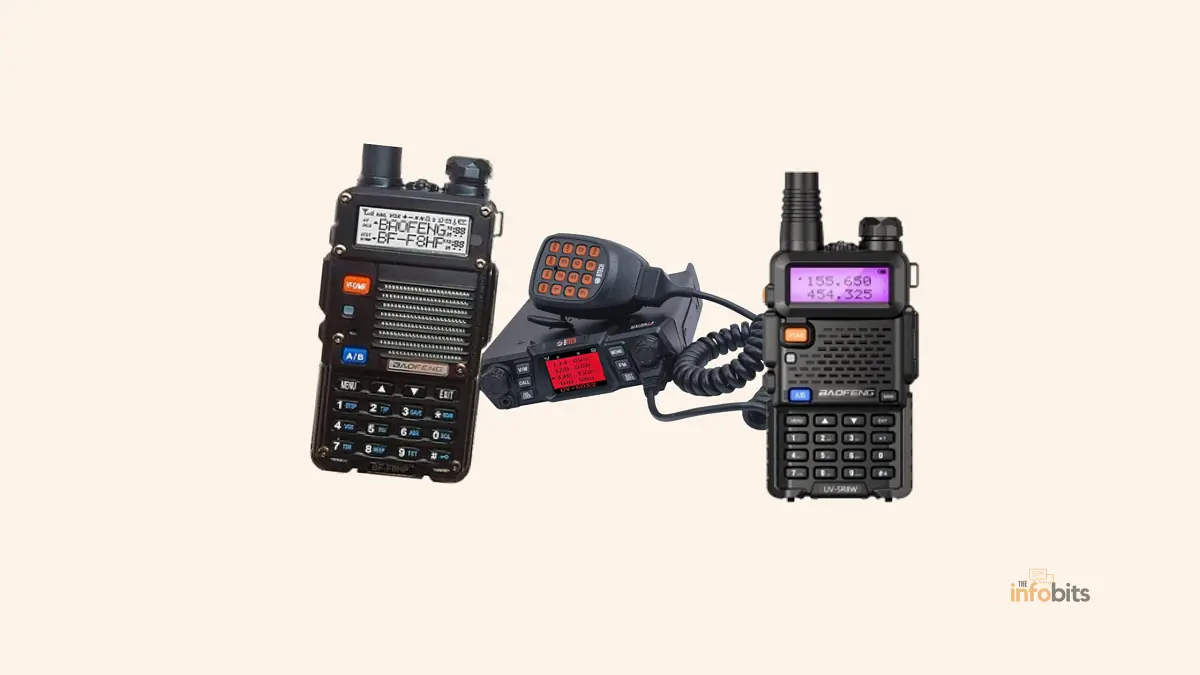
1. BAOFENG BF-F8HP PRO 10W : Best Overall
The BF-F8HP PRO is BTECH’s upgraded take on the long-running BF-F8HP, and it’s the best all-around beginner handheld on this list in 2026, thanks to genuinely useful additions rather than just a bigger number on the box.
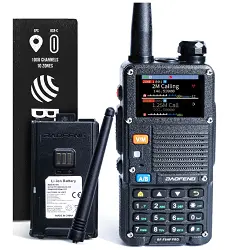
Key Specs:
- Output Power: rated 10W tri-band (independent spectrum testing measures closer to 5W on 2m / 6W on 70cm, still an improvement over the original F8HP)
- Frequency Range: VHF, UHF, and 1.25m (tri-band), plus aviation AM and NOAA weather receive
- Channels: Up to 1000 memory channels across 10 organizable zones
- Extras: Built-in GPS location tools, USB-C charging, IP54 rugged rating
- Certification: FCC Part 90 (see the Baofeng legality section above)
Pros:
- Genuinely useful zone/channel organization for beginners juggling multiple repeaters
- Tri-band coverage plus aviation/NOAA receive in one radio
- Noticeably better build quality and thicker manual than base Baofeng models
- Real firmware update support
Cons:
- Actual transmit power runs lower than the advertised 10W, per independent testing
- The menu system still takes time to learn
- Part 90 certification means you’re responsible for staying within amateur bands yourself
Who should buy it: Beginners who want the most capable, best-organized handheld on this list and don’t mind paying a bit more than the base UV-5R tier.
Our Take: This is our new top recommendation for a first serious handheld. It doesn’t fully live up to its power marketing, but the zone organization, tri-band coverage, and build quality genuinely make day-to-day use easier than older Baofeng models.
2. BAOFENG BF-F8HP : Best Value Classic
If the Pro version costs more than you want to spend, the original BF-F8HP remains a solid, well-supported choice. It’s simply been on the market longer and has a smaller feature set.
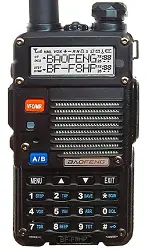
Key Specs:
- Output Power: rated 8W (independent testing measures closer to 4–5W on 2m / 2.5W on 70cm)
- Frequency Range: VHF 136–174 MHz, UHF 400–520 MHz (dual-band)
- Battery: 2100mAh Li-Po
- Channels: 128 memory channels, fully CHIRP-compatible
Pros:
- Lower price than the Pro version
- Large, established accessory ecosystem
- Well-documented, widely reviewed, and easy to find replacement parts for
Cons:
- No tri-band, GPS, or aviation receive
- Fewer memory channels than the Pro
- The same Part 90 certification caveat applies
Who should buy it: Budget-conscious beginners who want a known quantity without paying for features (GPS, tri-band, aviation receive) they may not use.
Our Take: Still a completely reasonable first radio. Choose this over the Pro if you just want a reliable dual-band handheld and don’t need the extras.
3. BAOFENG UV-5R 8W : Best Budget Pick
If you just want to try the hobby before spending real money, the UV-5R is the radio that’s introduced more people to amateur radio than perhaps any other single model on the market.
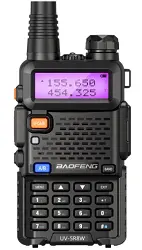
Key Specs:
- Output Power: rated 8W (independent testing measures closer to 3W on 2m / 1.4W on 70cm)
- Frequency Range: VHF 136–174 MHz, UHF 400–520 MHz
- Battery: 1800mAh Li-ion
Pros:
- Rock-bottom price point (often under $25)
- Simple enough to hand to a total beginner
- Same core capability as pricier Baofeng models
Cons:
- The lowest real-world transmit power of the Baofeng picks on this list
- Basic accessories compared to higher-tier models
- The same Part 90 certification caveat applies
Who should buy it: Anyone testing the waters before committing more money or buying a second/backup radio.
Buy the BAOFENG UV-5R on Amazon
Our Take: We started our own ham radio journey with an earlier version of this exact radio, and it’s still what we recommend to friends who “just want to see what this is about” before investing further.
4. BAOFENG 5RM Ham Radio 10W : Best Budget Tri-Band
The 5RM sits between the UV-5R and the BF-F8HP PRO: it adds tri-band coverage and a bigger battery over the base UV-5R, at a price that’s often closer to the UV-5R than to the Pro.
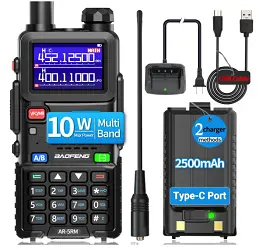
Key Specs:
- Output Power: rated 10W (mid/low power levels not published by the manufacturer)
- Frequency Range: VHF (2m), 1.25m, UHF (70cm), plus AM/FM and NOAA weather receive
- Channels: 999 memory channels
- Battery: 2500mAh, USB-C charging
- Certification: FCC Part 90
Pros:
- Tri-band coverage at a genuinely budget price point
- Ships with two antennas (short and long), so you can compare the gain immediately
- CHIRP-compatible for easy repeater programming
Cons:
- No published IP/water-resistance rating, despite some water-resistance marketing claims
- Programming without a computer takes some patience
- The same Part 90 certification issue applies
Who should buy it: Beginners who specifically want 1.25m band access without paying Pro-tier prices.
Our Take: A smart “in-between” pick if you want more than the UV-5R offers but aren’t ready to spend Pro-tier money.
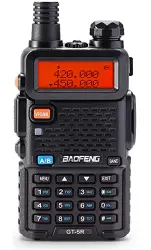
5. BAOFENG GT-5R Dual Band: Best “Simple & Compliant” Pick
The GT-5R is Baofeng’s direct answer to the certification concerns we outlined earlier: it’s factory-restricted to transmit only within the amateur 144–148 MHz and 420–450 MHz bands, with nothing else accessible.
Key Specs:
- Output Power: 5W
- Frequency Range: 144–148 MHz and 420–450 MHz only (no wideband transmit)
- Battery: 1800mAh
- Channels: 128, CHIRP-compatible
Pros:
- Removes the “could I accidentally transmit outside amateur bands” question entirely
- Simple, no-frills interface. Good for a true first-time user
- Priced close to the UV-5R despite the added certification clarity
Cons:
- Lower power and fewer channels than the tri-band picks above
- No GPS, aviation receive, or extra bands
- Still Part 90 rather than Part 97, though its restricted transmit range addresses the main practical concern
Who should buy it: Beginners who specifically want a Baofeng-priced radio without the “what frequencies can this actually transmit on” ambiguity, but aren’t ready to spend Yaesu money.
Our Take: An underrated pick. If the legality section above gave you pause, this is the cheapest way to sidestep the concern entirely while staying in Baofeng’s price range.
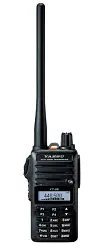
6. Yaesu FT-65 (FT-65R): Best Brand-Name Step-Up
If budget imports make you nervous and you’d rather pay a bit more for documented build quality, English-language support, and a manufacturer’s warranty, the FT-65R is the natural next step up.
Key Specs:
- Output Power: 5W / 2.5W / 0.5W selectable
- Frequency Range: 144–148 MHz and 430–450 MHz (dual-band)
- Battery: 1950mAh Li-ion (9+ hours), optional 2500mAh for 11.5+ hours
- Build: IP54 dust/water rating, MIL-810-C/D/E rugged standards
- Support: 3-year manufacturer warranty, full English documentation
Pros:
- Noticeably better build quality and audio clarity than budget imports, per independent reviews
- Documented commercial-grade durability standards
- Real manufacturer warranty and support channel
Cons:
- Roughly 3–5x the price of a UV-5R
- The stock antenna is of average quality; most owners upgrade it immediately
- Menu programming without a computer is more tedious than on some competitors
Who should buy it: Beginners willing to pay a premium for brand reliability and support, without going all the way to the FT-4XR’s explicit Part 97 certification.
Our Take: Reviewers consistently describe this as a meaningful step up from Baofeng-tier radios, even if it isn’t dramatically more powerful on paper. If you want “boring and reliable” over “cheap and uncertain,” this is a strong choice.
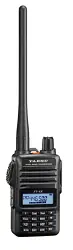
7. Yaesu FT-4XR : Best FCC-Certified Alternative
We keep this pick because it fills a real gap the Baofeng-only lineup would otherwise leave: a radio that’s explicitly certified for amateur use, at a price still accessible to beginners.
Key Specs:
- Output Power: 5W / 2.5W / 0.5W selectable
- Frequency Range: 144–148 MHz and 400–480 MHz (US version locked to amateur bands)
- Battery: 1750mAh Li-ion, roughly 9–15 hours of use
- Certification: FCC Part 97, locked to amateur frequencies in the US version
Pros:
- Genuine Yaesu build quality and reliable performance in independent lab tests
- No ambiguity about frequency certification
- Clean transmitter output with strong harmonic performance
Cons:
- More expensive than any Baofeng pick on this list
- Small front-panel buttons can be fiddly for larger hands
- Accessories aren’t compatible with other Yaesu handheld lines
Who should buy it: Beginners who specifically want a radio certified for amateur use out of the box, or who are willing to pay more for established brand reliability.
Our Take: If price were no factor, we’d recommend this over the Baofengs to nearly every new ham. It’s not a “better” radio in every spec, but it removes a whole category of certification questions that trip up beginners.
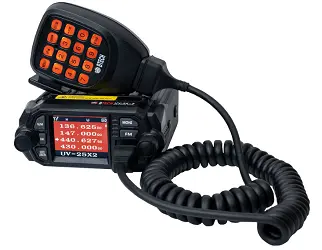
8. BTECH UV-25X2 (Second Gen.): Best Base/Mobile Radio
Every radio above is a handheld. If you want a compact home base station or vehicle-mounted setup with real range, the BTECH UV-25X2 is a strong, space-conscious next step.
Key Specs:
- Output Power: 25W high / 10W low, switchable
- Frequency Range: VHF 144–148 MHz, UHF 400–520 MHz (dual-band)
- Channels: 128 programmable memories
- Extras: Quad-watch receiver (monitor up to 4 frequencies/channels at once), RJ45 audio I/O with K1 adapter for accessory compatibility
- Power: Requires 13.6V DC (included cigarette-plug cable for vehicle use, or a separate power supply for a fixed base setup)
Pros:
- Genuinely compact; fits in tight vehicle spaces better than larger mobile radios
- 25W offers a real range step-up from any handheld on this list
- The quad-watch and dual-sync display are unusually useful features at this price
- US-based support and documentation from BTECH
Cons:
- Requires a separate power supply for home/base use (not included)
- No built-in battery, needs a constant power source
- Installation takes more planning than a handheld (mounting, power, antenna)
Who should buy it: Beginners ready to set up a compact home station or vehicle radio without committing to a bulkier 50W+ mobile unit.
Our Take: We swapped this in as our base/mobile pick specifically for its compact footprint. It delivers a real power and range upgrade over any handheld here while still fitting into tighter installs than bulkier mobile radios.
Bonus Pick: Best Antenna Upgrade – Nagoya NA-771
Every handheld radio on this list ships with a decent stock “rubber duck” antenna.
But swapping it for a longer aftermarket option like the Nagoya NA-771 is one of the cheapest, most effective upgrades a beginner can make. It noticeably improves reception and range for a cost usually under $25.
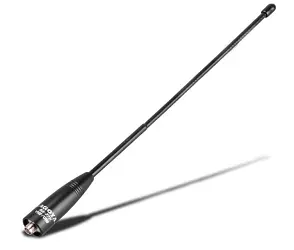
This isn’t a required purchase, but if you find yourself missing repeater hits or struggling with weak signals indoors, it’s the first accessory we’d suggest before blaming the radio itself.
Quick Comparison Table
| Radio | Type | Bands | Power (rated) | Certification | Best For |
|---|---|---|---|---|---|
| BAOFENG BF-F8HP PRO 10W | Handheld | Tri-band + aviation/NOAA RX | 10W | Part 90 | Best overall |
| BAOFENG BF-F8HP | Handheld | Dual-band | 8W | Part 90 | Best value classic |
| BAOFENG UV-5R 8W | Handheld | Dual-band | 8W | Part 90 | Lowest-cost entry |
| BAOFENG 5RM 10W | Handheld | Tri-band | 10W | Part 90 | Budget tri-band |
| BAOFENG GT-5R | Handheld | Dual-band (locked to ham bands) | 5W | Part 90, band-restricted | Simple & compliant |
| Yaesu FT-65R | Handheld | Dual-band | 5W | Commercial-grade cert. | Brand-name step-up |
| Yaesu FT-4XR | Handheld | Dual-band | 5W | Part 97 | Certified peace of mind |
| BTECH UV-25X2 | Mobile/Base | Dual-band | 25W | Part 90 | Compact base/mobile |
Note: We’ve intentionally left out exact pricing figures since prices on Amazon and other retailers shift frequently. Check the linked listings for current pricing.
Common Mistakes Beginners Make
- Buying before getting the licensed information sorted. You can own a radio without a license, but plan your study time so you’re not stuck listening-only for months.
- Trusting the advertised wattage at face value. Several budget radios measure noticeably lower in independent spectrum testing than their marketing claims. Treat listed power as a rough ceiling.
- Ignoring the frequency certification question entirely. You don’t need to panic about it, but you should understand it. See the details in the section above.
- Skipping CHIRP or manual programming. Learning to program your own memory channels (rather than paying someone else to do it) will teach you far more about how your radio actually works.
- Not budgeting for an antenna upgrade. The stock antenna is fine to start, but it’s usually the single biggest performance bottleneck.
Myth vs. Fact
| Myth | Fact |
|---|---|
| “Baofeng radios are illegal to own.” | False. Owning one is legal; the FCC enforcement actions target importers marketing them for use outside their certified bands. |
| “More watts on the box always means more range.” | Not necessarily; several budget handhelds measure well below their advertised wattage in independent testing, and antenna quality often matters more than raw power anyway. |
| “You need an expensive radio to talk long-distance.” | False for local contacts; repeaters extend a cheap handheld’s range dramatically. Long-distance (DX) contacts typically require HF equipment, a separate step up. |
Expert Tips for Getting Started
Setting Up Your Ham Radio Station
Pick a spot with a consistent power source and, ideally, some elevation or a window facing away from major obstructions if you’re using a base station like the UV-25X2.
An organized, dedicated space makes the learning curve far less frustrating.
Understanding Basic Ham Radio Terminology
Terms like QSO (a conversation), CQ (a general call inviting any station to respond), and simplex/duplex will come up constantly.
The ARRL glossary and most Technician study guides cover these in the first chapter. It’s worth reviewing before your first on-air contact.
Joining Ham Radio Communities and Clubs
Local clubs are genuinely one of the best resources available to a new ham. Most offer free “elmering” (mentorship), practice exam sessions, and hands-on help programming your first radio.
Resources and Support for New Ham Radio Operators
- Websites and forums: RadioReference, r/amateurradio, and QRZ.com forums are active and beginner-friendly.
- Books: The ARRL’s “Ham Radio License Manual” remains the standard beginner study resource.
- Local clubs and mentors: Search ARRL’s club finder tool for a group near you. Nothing replaces in-person help when you’re first learning to program a radio or set up an antenna.
Conclusion and Final Recommendations
For most beginners in 2026, the BAOFENG BF-F8HP PRO 10W is our top all-around pick, with tri-band coverage, GPS, and strong channel organization at a still-reasonable price.
If you’d rather save money, the classic BF-F8HP or the ultra-budget UV-5R 8W both remain solid starting points, and the 5RM 10W is worth a look if you specifically want tri-band coverage on a tight budget.
If the Baofeng certification question genuinely bothers you, the GT-5R solves it cheaply, while the Yaesu FT-65R and FT-4XR solve it with established brand backing. Pick the FT-4XR specifically if Part 97 certification matters most to you.
And if you’re setting up a home or vehicle station, the compact BTECH UV-25X2 gives you a real power step-up without a bulky footprint.
Whichever radio you choose, the most important step is the one before the purchase: get comfortable with the basics, study for your license, and find a local club or mentor if you can.
The radio matters less than most beginners think; the community and the learning curve are where the real hobby lives.
Quick Picks Summary
| Product | Category |
|---|---|
| BAOFENG BF-F8HP PRO 10W | Best Overall |
| BAOFENG BF-F8HP | Best Value Classic |
| BAOFENG UV-5R 8W | Best Budget Pick |
| BAOFENG 5RM 10W | Best Budget Tri-Band |
| BAOFENG GT-5R Dual Band | Best “Simple & Compliant” Pick |
| Yaesu FT-65R | Best Brand-Name Step-Up |
| Yaesu FT-4XR | Best FCC-Certified Alternative |
| BTECH UV-25X2 (2nd Gen.) Mini Mobile | Best Base/Mobile Radio |
| Nagoya NA-771 (bonus) | Best Antenna Upgrade |
Frequently Asked Questions
Can I start with any ham radio as a beginner?
Technically, yes, but radios built for beginners, with clearer menus, simpler programming, and better documentation, will get you on the air with far less frustration than jumping straight to advanced commercial-grade equipment.
Do I need a license to operate a ham radio as a beginner?
Yes. In the US, you need a valid amateur radio license from the FCC before transmitting on amateur frequencies. You can legally own a radio without one, but you can’t legally transmit until you pass the Technician exam.
How much should I budget for a beginner ham radio?
A solid beginner handheld typically costs between $20 and $130, depending on features and brand. Compact mobile/base radios like the UV-25X2 run higher. Prioritize the features that matter most to you (range, certification, ease of use) rather than chasing the cheapest or most expensive option automatically.
Is it true that Baofeng radios are illegal?
Not for individual owners. Most Baofeng handhelds are FCC Part 90-certified rather than Part 97, and FCC enforcement has focused on importers marketing them outside their certified bands, not on licensed hams using them within amateur frequencies.
What’s the difference between the BF-F8HP and the BF-F8HP PRO?
The Pro adds a third band (1.25m), aviation and NOAA receive, GPS location tools, USB-C charging, and more memory channels/zones. Independent testing shows its real-world transmit power is higher than the original F8HP, though still below its advertised 10W rating.
Which Baofeng should I buy if I want to avoid the certification concerns?
The BAOFENG GT-5R is factory-restricted to transmit only within the 144–148 MHz and 420–450 MHz amateur bands, which directly addresses the main practical concern behind the Part 90 certification debate.
Can I communicate with people worldwide using a beginner handheld radio?
Generally, no, not directly. Handheld VHF/UHF radios are built for local and regional contacts, typically extended through repeaters. Worldwide (DX) contacts usually require HF equipment and different antennas.
Is the advertised wattage on budget radios accurate?
Not always. Independent spectrum analyzer testing on several popular Baofeng models has found real-world output meaningfully below the advertised number, particularly on UHF. It’s still usable power for local repeater work, just not literally what’s printed on the box.
Do I need a separate antenna, or is the stock one good enough?
The stock antenna is fine to start with. Most beginners find that upgrading to an aftermarket antenna like the Nagoya NA-771 noticeably improves range and reception once they’re ready to invest a little more.
What’s a repeater, and why does it matter for beginners?
A repeater is a fixed station, usually on a hill or tall building, that automatically re-transmits your signal over a much wider area. Learning to use local repeaters is one of the first skills every new ham should pick up, since it dramatically extends a handheld’s usable range.
Can I program my own channels, or do I need special software?
Most beginner radios can be programmed manually from the keypad, but free software like CHIRP (for many Baofeng and compatible models) makes it far easier to load in local repeater frequencies from your computer.
Is a more expensive radio always better for a beginner?
Not necessarily. Price often reflects build quality, certification, and brand support rather than raw capability. A $25 Baofeng and a $90+ Yaesu can both get a beginner talking on local repeaters effectively. The difference is mostly in certification clarity, durability, and long-term reliability.
What accessories should a beginner budget for beyond the radio itself?
A spare battery, a programming cable (for computer-based setup), and an upgraded antenna are the three most commonly recommended first accessories.
Is the BTECH UV-25X2 a good first radio, or should I start with a handheld?
Start with a handheld unless you already know you want a fixed vehicle or home station setup. The UV-25X2 requires a separate power source and more installation planning, making it better suited as a second radio once you’re confident in the hobby.
What’s the realistic range of a beginner handheld radio?
Simplex (radio-to-radio, no repeater) range is often just 1–5 miles, depending on terrain. Through a repeater, that range can extend to 20-plus miles or more, which is why learning repeater use matters so much early on.
Please share this article with your friends and relatives if you find it useful.
We also ask that you bookmark this page for future reference, as we are constantly updating our articles with new information.
Sign up for our free newsletter as well to receive fresh information immediately in your inbox and keep technically up to date.
Disclosure: If you follow our links to a retailer’s website and make a purchase, we will get an affiliate commission on some, but not all, of the items or services we promote. This will cause no price change for you.