

IPS vs VA Panel TV: Which Is Actually Best? (2026 Comparison)
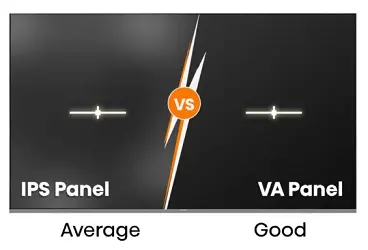
Quick answer: VA panels have deeper blacks and much higher contrast (often 3,000:1–6,000:1 vs. IPS’s roughly 1,000:1), making them the better pick for movie nights in a dim room. IPS panels have far wider viewing angles and hold color accuracy better off-center, making them the better pick if multiple people watch from the sides of the room. Most TVs today, including Samsung, Sony, TCL, and increasingly LG, use VA panels; IPS has become the minority option even in LG’s own lineup.
Screen size, brand, HDR support, and refresh rate all get plenty of attention when you’re shopping for a TV.
The panel technology underneath all of that. IPS or VA rarely gets mentioned on a spec sheet, but it has more influence on how your picture actually looks than almost anything else on the list.
This guide breaks down the real differences, clears up a genuinely common point of confusion around gaming, and shows you how to figure out which panel is actually inside the TV you’re considering, which, as you’ll see below, is harder than it should be.
How IPS and VA Panels Actually Differ
Both are LCD technologies, meaning an LED backlight shines through a layer of liquid crystals to produce the image. The difference comes down to how those crystals are oriented.
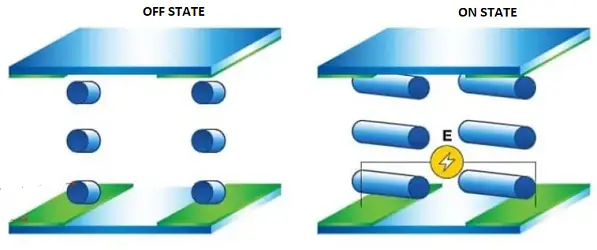
IPS (In-Plane Switching) aligns its liquid crystals horizontally, parallel to the glass. This orientation lets the crystals rotate in the same plane, which is what gives IPS its signature strength: the image holds up well even when you’re not looking at it head-on.
VA (Vertical Alignment) aligns its crystals vertically, perpendicular to the glass. When no voltage is applied, the crystals stay upright and block light almost completely, which is exactly why VA panels produce such deep, convincing blacks.
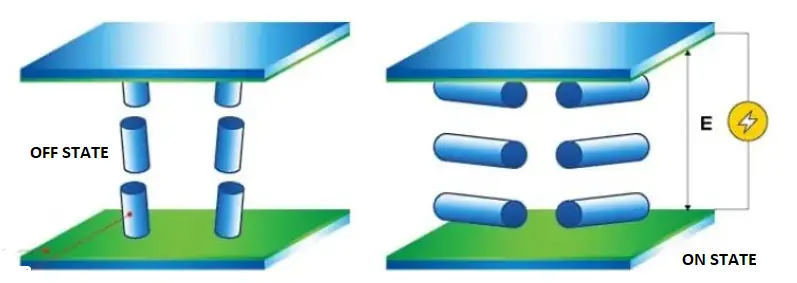
That single structural difference explains nearly every practical trade-off between the two.
Related: TV vs Monitor: Can We Use a Monitor as a TV?
IPS Panel TVs: Strengths and Weaknesses
Strengths:
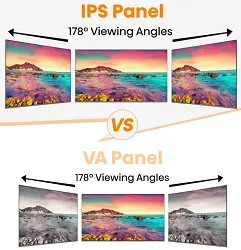
- Wide viewing angles; some IPS panels hold accurate color and contrast up to roughly 178°, so the picture doesn’t wash out from the side of the room.
- Faster response time; IPS panels typically respond in the 1–4ms range, which keeps fast motion looking clean with less blur.
- Strong, consistent color accuracy; IPS remains the go-to choice for photo editing, video work, and any use case where accurate color matters more than deep blacks.
Weaknesses:
- Lower contrast ratio; typically around 1,000:1, meaning blacks read as dark grey rather than true black.
- “IPS glow”: bright patches, most visible in the corners of the screen in dark scenes, caused by backlight bleeding through at extreme angles even from the front.
- Weaker shadow detail; dark tones tend to blend, losing detail in low-light scenes.
VA Panel TVs: Strengths and Weaknesses
Strengths:
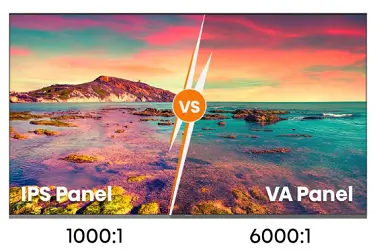
- Excellent contrast ratio; commonly 3,000:1 to 6,000:1, roughly 3–6x higher than standard IPS, producing genuinely deep blacks.
- Strong black uniformity; blacks stay consistent across the whole screen rather than looking patchy.
- Usually more affordable, VA has become the default panel type across most mainstream and premium LCD TVs, which keeps pricing competitive.
Weaknesses:
- Narrower viewing angles; contrast and color noticeably degrade past roughly 35–40° off-center, though high-end models have improved this significantly.
- Slower response time; typically a few milliseconds slower than IPS, which can show up as mild motion blur in fast content.
- Lower peak color volume on cheaper models, though this gap has narrowed with quantum-dot color layers now common across most VA TVs.
IPS vs VA: Head-to-Head Comparison
| Category | Winner | Why |
|---|---|---|
| Contrast ratio | VA | 3,000:1–6,000:1 vs. IPS’s ~1,000:1 ; noticeably deeper, more convincing blacks |
| Viewing angle | IPS | Holds color and contrast accurately up to ~178°; VA degrades past ~35–40° |
| Color accuracy (head-on) | IPS | Wider color gamut and more consistent accuracy, though quantum-dot VA has closed much of this gap |
| Black uniformity | VA | More consistent, deeper black across the whole panel |
| Response time | IPS | Typically, 1–4ms vs. VA’s slightly slower response, meaning less motion blur |
| Refresh rate ceiling | IPS | High-end IPS panels reach up to 360Hz; VA typically tops out lower, though 240Hz VA panels exist |
| Burn-in risk | Tie | Both are extremely low-risk LCD technologies; this isn’t a meaningful factor for either |
| Typical price | VA | More widely available across budget-to-premium TVs, keeping prices competitive |
Which Is Better for Watching Movies and TV?
VA is the clear pick here, and it’s not close. The deep blacks and high contrast ratio make a real, visible difference in dark or dimly lit scenes, the exact conditions most people watch movies and prestige TV dramas in.
If your seating is centered on the TV and you’re not regularly watching from a sharp side angle, VA’s advantages will matter far more day-to-day than IPS’s wider viewing angle.
IPS becomes the better choice specifically when your seating isn’t centered, a wide living room with a couch on both sides, or a kitchen TV that people glance at from an angle.
In that scenario, VA’s contrast advantage matters less than being able to actually see accurate color and contrast from where people are sitting.
Which Is Better for Gaming?
This is where a lot of comparison articles, including outdated versions of guides, get the recommendation backwards, so it’s worth being precise.
For fast-paced, competitive games (shooters, fighting games, racing), IPS is the better choice. Its faster response time and higher refresh-rate ceiling mean less motion blur and smoother-looking fast movement, genuinely useful when reaction time matters.
For immersive, atmospheric single-player games (open-world RPGs, horror, story-driven titles), VA is the better choice. The deep contrast makes dark environments and night scenes look dramatically better, the same way it helps with movies.
Both panel types can now hit 120Hz, and some premium models reach 144Hz–240Hz, so raw refresh rate is no longer a reliable way to tell them apart the way it once was. The right pick genuinely comes down to what you play, not which panel is “better” in the abstract.
How to Actually Check Which Panel Is in a TV
This is more frustrating than it should be. Manufacturers rarely list panel type on the spec sheet, and it’s increasingly common. A practice sometimes called the “panel lottery”, for the same TV model to ship with either panel, depending on size or region.
LG’s QNED lineup is the most well-documented example: several models have shipped with an IPS panel in one screen size and a VA panel in another, with no way to tell which one you’re getting just from the model number on the box.
A few ways to actually find out before you buy:
- Search the exact model number (including the size) alongside “panel type”. Enthusiasts display sites like RTINGS and FlatpanelsHD, which frequently publish confirmed panel types per model and size.
- Check the return policy and, if in doubt, buy from a retailer with an easy return window in case the unit you receive doesn’t match what you expected.
- Look at the viewing-angle spec if it’s listed; panels with a stated viewing angle close to 178° are IPS; panels with no angle claim or a narrower stated range are usually VA.
- As a rule of thumb for 2026: most Samsung (Neo QLED), Sony, and TCL LCD TVs use VA panels. LG’s OLED and QNED Mini-LED lineups increasingly mix VA and IPS/ADS panels depending on size, whereas LG’s traditional NanoCell TVs have historically leaned toward IPS.
Related: NanoCell vs OLED: Which TV Technology Is Better?
What About Mini-LED and OLED?
Panel type (IPS vs. VA) only applies to LCD TVs. It describes how the liquid crystal layer is built, and both types still rely on an LED backlight shining through it.
Mini-LED is a backlight upgrade, not a panel type. It can be paired with either an IPS or a VA panel, and it significantly improves both technologies’ weak points by using far more, far smaller dimming zones for better local contrast control.
OLED TVs, including QD-OLED models, use a completely different display technology. Unlike IPS and VA panels, OLED screens don’t need a backlight. Each pixel creates its own light and can be turned off individually. This allows OLED TVs to deliver near-perfect black levels, outstanding contrast, and wide viewing angles at the same time.
That combination is something IPS and VA panels can’t fully match. However, OLED TVs usually cost more than LCD-based models. They also have a small risk of burn-in, although modern OLED TVs include features that greatly reduce this issue. Burn-in is an important topic, but it’s separate from the IPS vs. VA comparison.
Common Mistakes When Choosing a Panel Type
- Assuming the panel type is fixed for a brand. Samsung’s Neo QLED lineup is consistently VA, but LG’s lineup has genuinely mixed VA and IPS panels within the same model line. Don’t assume based on brand alone.
- Prioritizing panel type over local dimming quality. A well-implemented Mini-LED backlight can meaningfully close the contrast gap on an IPS TV, and a poorly implemented one can undercut a VA panel’s natural advantage. Panel type is one factor, not the whole picture.
- Buying a VA panel for a wide, multi-seating living room. If people regularly watch from sharp angles, VA’s narrow viewing angle will be a daily annoyance, no matter how good its contrast is.
- Overweighting response-time specs for casual, non-competitive gaming. The IPS response-time advantage matters most in twitch-reflex genres; it’s a much smaller factor for turn-based, strategy, or story-driven games.
Myth vs. Fact
Myth: “VA panels are always better because they have higher contrast.” Fact: Contrast is one factor among several. If your seating isn’t centered on the TV, VA’s narrow viewing angle can be a bigger practical problem than its contrast advantage is a benefit.
Myth: “IPS is always the better panel for gaming.” Fact: It depends on the genre. IPS wins for fast, competitive games where motion clarity matters; VA wins for atmospheric, dark-scene-heavy single-player games.
Myth: “You can tell the panel type just from the TV’s brand or series name.” Fact: Not reliably. The “panel lottery” phenomenon means identical model numbers can ship with different panels depending on screen size or region, particularly for LG.
Myth: “Panel type doesn’t matter anymore because of Mini-LED and quantum dots.” Fact: Those technologies meaningfully improve both panel types’ weaknesses, but they don’t erase the fundamental IPS-vs-VA trade-off between viewing angle and native contrast.
IPS vs VA: Which Should You Choose?
- Choose VA if: you mostly watch in a dim or dark room, care most about deep blacks and contrast for movies and dramas, seating is centered on the TV, and you want the widest selection at a given price point.
- Choose IPS if: your seating is spread across a wide room or off to the sides, you watch in a brighter room where deep blacks matter less, or you play fast-paced competitive games where motion clarity is a priority.
- Either works well if you’re buying a premium Mini-LED model, since strong local dimming narrows the practical gap between the two considerably.
For the average household watching movies and shows from a centered couch, VA remains the more broadly recommended choice, which also happens to be why it’s become the default panel across most of the TV market.
If your room setup or gaming style benefits more from an IPS panel, it’s still an excellent choice. Choosing IPS is not a downgrade. It simply offers a different balance of strengths and compromises. The right option depends on how and where you use your display.
Related: Where Should You Place a TV Soundbar for the Best Listening Experience?
Final Thoughts
Choosing between an IPS and a VA panel isn’t about finding a single winner. It’s about finding the TV that best fits your viewing habits.
If you want deep blacks and higher contrast for movie nights, a VA panel is usually the better choice.
If your family watches from different angles or you value wider viewing angles, an IPS panel may be the smarter option. As this guide explains, the best TV is the one that matches your room, your budget, and how you use it.
Before you buy, take a few minutes to check the exact panel type for the TV model you’re considering. A little research can help you avoid surprises and make a more confident purchase.
Frequently Asked Questions
What’s the main difference between IPS and VA panels?
IPS panels align liquid crystals horizontally, giving wide viewing angles but lower contrast. VA panels align crystals vertically, giving deep contrast and true blacks but a narrower viewing angle.
Which panel is better for watching movies?
VA panels are generally better for movies, especially in dim or dark rooms, because their significantly higher contrast ratio produces deeper, more convincing blacks in dark scenes.
Which panel is better for gaming?
It depends on the game. IPS is better for fast-paced competitive games due to faster response times and less motion blur. VA is better for atmospheric single-player games where deep contrast in dark scenes matters more.
Do all Samsung TVs use VA panels?
Samsung’s Neo QLED and most other LCD TV lines consistently use VA panels, making Samsung one of the more predictable brands for panel type.
Does LG use IPS or VA panels?
Both, depending on the model and size. LG’s traditional NanoCell TVs have leaned towards IPS, but recent QNED Mini-LED models have increasingly mixed in VA panels. sometimes within the same model number, depending on screen size, a practice known as the “panel lottery.”
How can I find out which panel is in a specific TV before buying?
Search the exact model number and screen size alongside “panel type” on an enthusiast review site like RTINGS or FlatpanelsHD, since manufacturers rarely list this on the official spec sheet.
Is IPS or VA better for a bright room?
IPS tends to perform better in brighter rooms because ambient light matters less when contrast is already lower, and its wider viewing angle helps if seating isn’t directly centered on the screen.
What is “IPS glow”?
IPS glow is a visible brightening, usually in the corners of the screen, caused by backlight leaking through the panel at certain angles, most noticeable in dark scenes and dark rooms.
Why do VA panels have narrow viewing angles?
Because their liquid crystals are aligned vertically and only tilt to let light through when viewed close to head-on, viewed from a sharp angle, less light reaches your eyes, which washes out contrast and color.
Does Mini-LED backlighting change the IPS vs. VA comparison?
It significantly narrows the practical gap for both. Mini-LED’s finer local dimming zones improve contrast on IPS panels and improve blooming control on VA panels, but the underlying viewing-angle and contrast trade-off between the two panel types still applies.
Is OLED better than both IPS and VA?
For picture quality, generally yes. OLED offers near-perfect blacks and wide viewing angles simultaneously, avoiding the limitation inherent to LCD panels. It comes at a real price premium and isn’t a direct like-for-like comparison, since it’s a different underlying technology.
Can two TVs with the same model number have different panels?
Yes. This is the “panel lottery” issue, most documented with LG’s QNED lineup, where the same model number can ship with either an IPS or VA panel depending on screen size or the region it’s sold in.
Which panel type has better color accuracy?
IPS generally has the edge in raw color accuracy and gamut, though quantum-dot color layers, now standard on most VA TVs, have closed much of that gap for everyday viewing.
Is response time a big deal for casual TV watching?
Not really. The difference between IPS and VA response times is most noticeable in fast-paced competitive gaming; for regular TV and movie watching, it’s rarely something you’ll consciously notice.
Which panel type is more common in TVs sold today?
VA is now the more common panel type across most major TV brands, including Samsung, Sony, and TCL. IPS remains more common in computer monitors and in parts of LG’s TV lineup.
If you found this IPS vs. VA Panel TV comparison helpful, please share it with your friends and family. Also, follow The Infobits on Facebook and X (formerly Twitter) for more TV buying guides, honest product comparisons, troubleshooting tips, and the latest tech updates.
We also ask that you bookmark this page for future reference, as we are constantly adding new information to our articles.
Sign up for our free newsletter as well to receive fresh information immediately in your inbox and keep technically up to date.
Disclosure: If you follow our links to a retailer’s website and make a purchase, we will get an affiliate commission on some, but not all, of the items or services we promote. This will cause no price change for you.




)