AVOD vs FAST: What’s the Difference and Which Is Right for You?
Free streaming has never been more popular, and never more confusing.
If you’ve tried to make sense of terms like AVOD, FAST, SVOD, and HVOD without ending up more puzzled than when you started, you’re not alone. The streaming industry has a habit of wrapping simple ideas in dense acronyms.
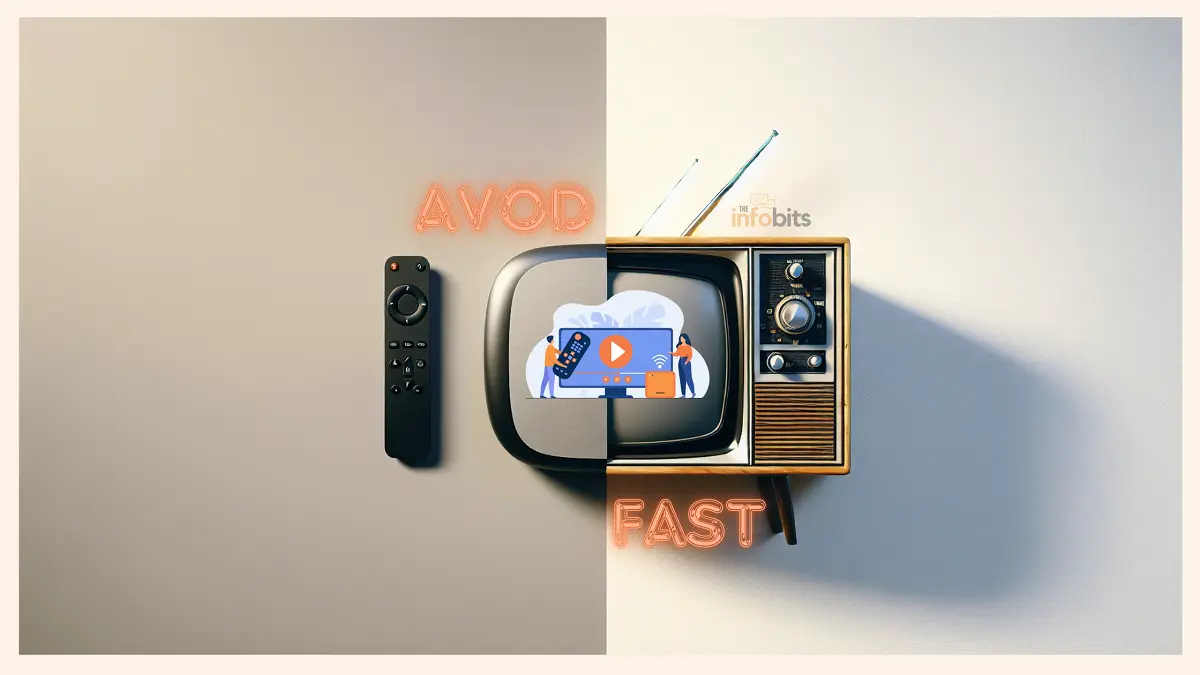
Quick Answer: Here’s what you actually need to know: AVOD and FAST are both free, ad-supported ways to watch streaming content, but the experience they deliver is very different. AVOD works like a library where you choose what to watch.FAST works like a TV set where you tune into channels that are already playing.
This guide breaks down exactly what each model is, how they differ, what the major platforms are, and how to decide which one, or which combination, makes sense for you as a viewer, advertiser, or content creator.
AVOD vs FAST at a Glance
| AVOD | FAST | |
|---|---|---|
| Full name | Ad-Supported Video on Demand | Free Ad-Supported Streaming TV |
| How you watch | Choose a title, press play | Tune into a scheduled channel |
| Content structure | On-demand library | Linear scheduled programming |
| Cost to the viewer | Free (or discounted with ads) | Always free |
| Viewing control | Full; pause, rewind, skip | Limited, like live TV |
| Ad targeting | Highly personalised and data-driven | Demographic-based, TV-style slots |
| Best for viewers who… | Want to choose exactly what to watch | Prefer a lean-back, channel-surfing experience |
| Top platforms | YouTube, Tubi (on-demand), Peacock, Hulu (ad tier) | Pluto TV, The Roku Channel, Tubi (linear), Samsung TV Plus |
Related: FAST vs. SVOD: Which Streaming Model Should You Use?
What Is AVOD?
AVOD stands for Advertising-based Video on Demand. It’s a streaming model where viewers get access to a library of movies, TV shows, and videos for free, in exchange for watching advertisements during playback.
The experience is essentially identical to a paid subscription service like Netflix, except commercial breaks are inserted periodically.
You search for a title, press play, and watch it whenever you want. You can pause, rewind, and pick up where you left off. The only difference is the ads.
Think of AVOD like YouTube (for free, user-generated content) or Tubi (for movies and TV series). You open the app, browse or search a catalog, and watch your chosen title on your own schedule.
Ads appear before or during playback, typically at intervals similar to traditional TV. But with fewer total ads, since the per-impression value is higher when they’re better targeted.
How AVOD generates revenue
AVOD platforms make money through targeted advertising. The key advantage over traditional TV advertising is data.
AVOD platforms know exactly who is watching, their age, interests, viewing history, location, and browsing behaviour, and use that information to match ads to the right viewers.
This makes each ad impression more valuable to advertisers, which in turn funds the free content for viewers.
Because of this targeting advantage, AVOD can carry less-intrusive ad loads than traditional TV while still earning meaningful revenue per viewer.
A study by Tubi and Harris Poll in early 2026 found that 68% of viewers prefer free ad-supported content over paid subscriptions that still include ads; a figure that reflects just how acceptable the AVOD trade-off has become.
Is AVOD always completely free?
Not always, and this is where things get slightly blurry. Originally, AVOD meant completely free content supported by ads.
Today, many platforms use AVOD to describe their ad-supported subscription tiers; for example, Netflix’s Standard with Ads plan, Disney+’s ad-supported tier, or Hulu with Ads.
These require payment, but at a lower price than the ad-free tier. Some analysts consider these AVOD; others classify them as a hybrid model (HVOD).
For simplicity, pure AVOD is free with ads. Ad-supported subscription tiers charge a reduced fee but still include ads. Both use advertiser-funded content as a core component.
Top AVOD platforms (2026)
- YouTube: the largest AVOD platform in the world, spanning user-generated content and professional programming
- Tubi (Fox): 100 million+ monthly active users, an enormous on-demand library of movies and TV series
- Peacock (NBCUniversal): combines free AVOD tiers with paid options, including live sports
- Hulu (with Ads): premium content with a lower-cost ad-supported subscription
- Crackle (Sony): free movies and TV shows with ads
- Pluto TV (on-demand section): available alongside their FAST channels
What Is FAST?
FAST stands for Free Ad-Supported Streaming TV. It’s a streaming model that replicates the experience of traditional cable TV.
It is complete with scheduled channels, a live programming grid, and the familiar act of flipping between channels to find something to watch. It delivers it for free over the internet, funded entirely by advertisements.
Unlike AVOD, you don’t choose a specific title and press play. Instead, you open a FAST platform and find hundreds of themed channels already in progress.
There’s a horror movie channel, a true crime channel, a cooking channel, a news channel, classic westerns, and dozens more.
Each channel is running a continuous stream of curated content. You pick a channel, sit back, and watch whatever happens to be on; exactly like traditional TV.
This is sometimes called the “lean-back” experience, and it’s intentionally designed to feel effortless. No browsing, no decisions, no algorithm to fight. Just channels to surf.
Related: What are FAST Channels and What is their Future?
How FAST generates revenue
FAST platforms sell ad slots within the scheduled programming stream, similar to how broadcast or cable TV has always worked. Advertisers buy time in specific channels or content categories, and ads are inserted at fixed intervals during the broadcast.
The targeting is typically demographic-based (genre, channel type, general audience profile) rather than hyper-personalised, though this is evolving rapidly with improvements in connected TV ad technology.
One key technology driving FAST ad delivery is Server-Side Ad Insertion (SSAI), which stitches ads directly into the video stream. This makes ads indistinguishable from regular content at the network level and is now the industry standard for major FAST platforms.
FAST is always completely free
Unlike AVOD, FAST services have no paid tier or subscription option. They are entirely free, with no sign-up required on many platforms.
Samsung TV Plus, for example, is built directly into Samsung smart TVs and requires no account, no payment details, and no registration. You turn on the TV, and it’s there.
Top FAST platforms
- Tubi (Fox): largest FAST platform by monthly active users, now exceeding 100 million globally. Uniquely, Tubi skews heavily on-demand (over 95% of viewing is on-demand), making it a bridge between FAST and AVOD.
- The Roku Channel: available on Roku devices and via the web; claimed a record 3% of total US TV viewership in December 2025
- Pluto TV (Paramount): a FAST pioneer offering 250+ live channels in the US; one of the clearest examples of the classic linear FAST model
- Samsung TV Plus: pre-installed on all Samsung smart TVs since 2016; surpassed 100 million global monthly active users in 2026
- Xumo Play (Comcast): hundreds of free channels with a broad genre mix
- LG Channels: built into LG smart TVs
- Amazon Freevee: Amazon’s FAST offering, integrated with Prime Video devices
Related: Apple TV vs Roku: A Comprehensive Comparison
AVOD vs FAST: The Key Differences Explained
1. How you watch (on-demand vs linear)
This is the single biggest difference between AVOD and FAST, and everything else follows from it.
AVOD is on-demand. You open an app, browse a catalog, search for what you want, and press play. You’re in full control of what you watch and when.
You can pause mid-scene, come back three days later, and pick up exactly where you left off. The experience is identical to Netflix or Disney+, just with ad breaks.
FAST is linear. Content is scheduled in advance, running continuously like a traditional TV channel. You can’t start a movie from the beginning if it’s already 40 minutes in. You can’t pause and resume.
You tune into whatever is currently playing on that channel. It’s designed for browsing and discovery; you channel-surf until something catches your eye, then settle in.
This difference matters enormously for viewer behaviour. AVOD suits intentional viewing: you know what you want to watch, and you go get it. FAST suits passive viewing: you don’t have a specific title in mind, and you want something to fill the time with minimal effort.
Related: Understanding RTMPS: The Secure Streaming Protocol
2. Advertising approach
AVOD uses data-driven, personalised ad targeting. The platform knows your viewing history, demographics, and behavioural signals, and uses that to match advertisements specifically to you.
A viewer who watches cooking content gets food and kitchen product ads. A viewer who watches sports content gets athletic brand ads.
This precision makes AVOD ads more effective per impression and therefore more valuable to advertisers, which is why AVOD can sustain itself with relatively light ad loads.
FAST uses scheduled, slot-based advertising. Ads are sold in fixed slots across channels, similar to how traditional broadcast TV has always worked.
The targeting is broader, based on the channel’s genre and general audience profile rather than individual viewer data, though programmatic improvements are closing this gap.
For advertisers who are used to buying TV, FAST is a familiar and comfortable environment.
3. Pricing and access
AVOD can be fully free (like YouTube or Tubi’s on-demand library) or can take the form of a discounted ad-supported subscription tier (like Netflix Standard with Ads at a lower monthly price than the ad-free plan). Both are AVOD in the broader sense.
FAST is always free. There is no paid tier, no premium version, and often no account required at all. This zero-friction access model is one of FAST’s greatest strengths. It removes every barrier between the viewer and the content.
4. Content structure and discovery
AVOD platforms organise content in libraries; searchable catalogs sorted by genre, release date, popularity, and algorithmic recommendations tailored to your history.
Discovery is active: you’re looking for something. The breadth of choice is AVOD’s strength, but it can also create decision paralysis when you’re not sure what you want.
FAST platforms organise content in themed channels; curated streams where the platform has done the curation for you.
Discovery is passive: you browse channels by name or genre until something grabs you. The lineup is predictable and familiar, which suits viewers who are accustomed to the traditional TV experience of turning on the TV and having something ready to watch.
5. Viewer control
AVOD gives full playback control: pause, rewind, fast-forward (sometimes after a delay), and watch at any time you choose.
FAST gives minimal playback control, similar to live TV. On most FAST platforms, you can’t pause or rewind a live channel (though some offer a short buffer).
You watch what’s on, when it’s on. Some FAST platforms also offer on-demand libraries alongside their channels, giving viewers the option to switch between the two experiences.
Why AVOD and FAST Are Both Growing So Fast
The context matters here, and it’s changed significantly since just a few years ago.
Subscription fatigue is real. The average US household now subscribes to approximately 4.2 streaming services, down from 5.1 in 2023. People are actively cutting back on paid subscriptions, and both AVOD and FAST have grown directly as a result.
The numbers reflect this shift clearly. FAST viewership in the US surged 43% year-on-year through August 2025, reaching 1.8 billion hours.
An estimated 131 million US viewers, roughly 54% of all connected TV users, are projected to use FAST services in 2026.
The global FAST market, valued at $10.6 billion in 2025, is projected to reach $12.23 billion in 2026 and $41.3 billion by 2035, growing at a compound annual rate of 15.4%.
Meanwhile, AVOD is pulling major platform investment. Netflix’s ad-supported tier has 94 million monthly active users globally and is already generating over $3.2 billion annually. By Q3 2025, roughly 40% of Netflix’s active accounts were on its ad-supported plan.
Amazon Prime Video added ads to its default tier in 2024 and now operates as a hybrid platform. Disney+ has similarly restructured around ad-supported growth.
What this tells us is that free and ad-supported content is no longer a niche or a fallback. It is the direction the industry is moving.
The Blurring Lines: Platforms That Do Both
Here’s something important to understand: AVOD and FAST are not always separate services. Most major free streaming platforms now offer both experiences under the same roof.
Tubi is the clearest example. It’s classified as a FAST platform (and regularly tops FAST rankings), but over 95% of Tubi’s actual viewing is on-demand, making it behave more like AVOD in practice. It offers both linear channels and an extensive on-demand library simultaneously.
Pluto TV runs hundreds of linear FAST channels alongside a growing on-demand library.
The Roku Channel offers both scheduled FAST programming and an on-demand section.
This convergence means that for most viewers choosing a free streaming service, the AVOD vs FAST distinction matters less than it once did, because the leading services provide both.
What matters more is understanding what kind of experience you’re in the mood for at any given moment.
AVOD vs FAST vs SVOD: Where Do They All Fit?
To put AVOD and FAST in their full context, it helps to understand how they relate to the other streaming models.
SVOD (Subscription Video on Demand): Pay a monthly fee, get an ad-free library. Netflix (premium tier), Disney+ (ad-free), HBO Max, Apple TV+. This was the dominant model for most of the past decade, but growth has stalled as subscription fatigue has set in.
AVOD (Ad-Supported Video on Demand): Free or discounted on-demand library, supported by ads. YouTube, Tubi (on-demand), Netflix Standard with Ads, Disney+ (ad-supported tier).
FAST (Free Ad-Supported Streaming TV): Free linear channels, always on, no sign-up required. Pluto TV, The Roku Channel, Samsung TV Plus, Tubi (linear section).
TVOD (Transactional Video on Demand): Pay per title. Apple TV purchases, Google Play Movies, and Amazon rentals. Used for new releases or premium content outside of subscription windows.
HVOD (Hybrid Video on Demand): Multiple models in one platform. Netflix now operates as HVOD (SVOD + AVOD tiers). YouTube combines AVOD + SVOD (YouTube Premium) + TVOD (movie rentals). This is the dominant model for major platforms in 2026.
Related: Ultimate Guide to PVOD Streaming: Everything You Need to Know
What AVOD and FAST Mean for Viewers
As a viewer, here’s how to think about it:
Choose AVOD (on-demand) when:
- You have a specific movie or show in mind and want to watch it immediately
- You like browsing a catalog and picking based on your mood
- You want full playback control (pause, rewind, resume later)
- You’re willing to spend a few seconds deciding what to watch
Choose FAST (linear channels) when:
- You want to turn on the TV and have something ready without making decisions
- You miss the experience of channel-surfing from your cable days
- You’re happy to watch whatever is on a themed channel you enjoy
- You want completely frictionless access with no sign-up or account
Realistically, you’ll want both. Most leading free streaming services now offer both experiences, and switching between them takes seconds.
What AVOD and FAST Mean for Advertisers
The two models offer advertisers very different opportunities:
AVOD advertising offers precision targeting at scale. You’re buying a specific audience based on rich behavioural and demographic data, not just a time slot.
Your ad reaches the viewer most likely to respond to it, regardless of what content they’re watching. This drives higher engagement rates and better return on ad spend, but requires more sophisticated data infrastructure to execute well.
FAST advertising offers a familiar, TV-like buying environment. You’re purchasing time in specific channels or content categories, similar to how you’d buy cable TV spots.
It’s comfortable for brands accustomed to traditional media planning, offers brand-safe contextual alignment (your ad appears in a relevant genre), and is increasingly enabling programmatic buying and addressable targeting as the technology matures.
For advertisers with budgets typically reserved for traditional TV, FAST is the most natural on-ramp into streaming advertising. For digital-native advertisers who are used to precision targeting on social media and search, AVOD offers the closest equivalent on a TV screen.
What AVOD and FAST Mean for Content Creators
For content creators, AVOD offers:
- Broad reach through large, searchable libraries
- Ongoing revenue potential tied to viewing hours and ad impressions
- Opportunity for data-driven audience insights
- Revenue that can be inconsistent and dependent on platform traffic and advertiser demand
FAST offers:
- A place in scheduled programming that mirrors traditional TV distribution
- Predictable ad slot revenue shared with the platform
- The challenge of visibility among a growing number of channels (nearly 1,870 FAST channels operate globally as of mid-2025)
- Often has lower content licensing costs than premium SVOD, since back-catalog and library content perform well in FAST environments.
Many content owners are now pursuing both, licensing back-catalog content to FAST channels for passive revenue while using AVOD platforms for more prominent, searchable placement of newer titles.
Myth vs Fact: Common AVOD and FAST Misconceptions
Myth: AVOD and FAST are the same thing. Fact: They share the same funding model (advertising) but deliver completely different viewing experiences. AVOD is on-demand; FAST is linearly scheduled programming.
Myth: FAST is just for older viewers who miss cable TV. Fact: FAST audiences skew younger than many assume. Over half of Tubi’s viewers are Gen Z or Millennials, and 67% are cord-cutters or cord-nevers, people who may never have had a traditional cable subscription.
Myth: AVOD always means the content is free. Fact: The term AVOD is now applied to ad-supported subscription tiers (like Netflix Standard with Ads) that do charge a fee, just a lower one. “Free with ads” is pure AVOD; “discounted with ads” is also increasingly called AVOD, or sometimes HVOD.
Myth: FAST channels are full of outdated, low-quality content. Fact: According to Nielsen, more than 70% of FAST programming has been produced since 2010. Platforms are actively investing in more recent and original content. Tubi simulcast Super Bowl LIX in early 2025, a landmark moment for the format’s legitimacy.
Myth: SVOD will eventually replace AVOD and FAST. Fact: The opposite is happening. Ad-free SVOD penetration fell 3% between Q1 and Q2 2025 as subscription fatigue accelerated. AVOD and FAST are the growth engines of the streaming industry, while pure SVOD growth has stalled in mature markets.
Expert Tips: Getting the Most from Free Streaming
- Use FAST for discovery, AVOD for intention. If you’re not sure what you want to watch, browse FAST channels. If you know what you want, search an AVOD library for it.
- Layer your streaming stack. A combination of one or two paid SVOD services (for premium content you actively want) plus free FAST and AVOD services for everything else gives you enormous value for a reasonable cost.
- Check ad-supported tiers before assuming you need the premium plan. Netflix’s ad-supported tier costs significantly less than the premium plan and delivers the same content catalog. The ad load is lighter than traditional TV and may be a fair trade for many viewers.
A quality streaming device like the Roku Streaming Stick or Amazon Fire TV Stick gives you access to all major FAST and AVOD platforms in one place on any TV. Both are available on Amazon and are a simple, low-cost way to consolidate your free streaming access.
- Use Smart TV pre-installed apps for zero-friction FAST. If you have a Samsung, LG, or Vizio smart TV, Samsung TV Plus, LG Channels, or WatchFree+ is already installed and ready; no setup required. Turn it on and start watching.
- Be aware of data collection. Both AVOD and FAST platforms collect viewing data to target ads. If privacy is a concern, review the privacy settings in each platform’s app and opt out of personalised advertising where available.
Related: What is Cloud TV, and how is it different from OTT?
Final Thoughts
AVOD and FAST are both responses to the same problem: viewers want great content without paying more subscription fees, and advertisers want to reach those viewers.
The two models solve that problem in different ways, one through on-demand control, the other through the familiar experience of scheduled TV.
For most viewers in 2026, the practical answer is to use both. The best free streaming services already offer both FAST channels and AVOD libraries in a single app, so there’s no reason to choose.
You can channel-surf when you’re in a passive mood and browse a catalog when you know what you want, all for free.
What’s clear is that ad-supported streaming is no longer the secondary option. It’s the primary direction the industry is heading, and it’s delivering more content and a better experience than ever before.
Frequently Asked Questions
What is the simplest difference between AVOD and FAST?
AVOD works like Netflix; you choose what to watch from a library. FAST works like cable TV; you tune into channels that are already playing scheduled content. Both are free and funded by ads.
Is FAST or AVOD better for viewers?
It depends on how you like to watch. AVOD is better if you know what you want and prefer on-demand control. FAST is better if you want a relaxed, channel-surfing experience with no decisions to make. Most viewers enjoy both depending on their mood.
Is YouTube AVOD or FAST?
YouTube is primarily AVOD; you choose specific videos to watch on demand. YouTube TV, a separate paid service, provides live TV channels more similar to the FAST model. YouTube also has some FAST-like features through its live channels, but its core is on-demand.
Is Tubi AVOD or FAST?
Tubi is technically classified as a FAST platform, but over 95% of its viewing is on-demand, making it behave more like AVOD in practice. It offers both linear channels and a large on-demand library simultaneously, making it a hybrid.
Is Pluto TV AVOD or FAST?
Pluto TV is primarily a FAST platform, built around its hundreds of linear scheduled channels. It also has an on-demand section, but its identity and most of its viewing are tied to the channel-surfing experience.
Do AVOD and FAST platforms have the same content?
Not necessarily. AVOD platforms tend to focus on building searchable libraries with broad genre coverage. FAST platforms curate themed channels, often specialising in genres like true crime, classic films, news, or sports. Some titles appear on both; many are exclusive to one format.
Why are AVOD and FAST growing so fast?
Subscription fatigue. The average US household now subscribes to fewer streaming services than in 2023, and many viewers are cutting paid subscriptions in favour of free alternatives. Both AVOD and FAST benefit directly from this trend, as does the broader shift toward ad-supported streaming across the entire industry.
Do I need to sign up or pay for FAST channels?
No. FAST services are always free, and many require no account or registration at all. Samsung TV Plus, for example, is built into Samsung smart TVs and requires nothing from the viewer. Pluto TV and Tubi can be used without creating an account, though signing up gives access to features like watchlists.
What is HVOD, and how does it relate to AVOD and FAST?
HVOD (Hybrid Video on Demand) refers to platforms that combine multiple monetisation models; for example, offering both a paid ad-free tier (SVOD) and a free or discounted ad-supported tier (AVOD). Netflix, Disney+, and Hulu all operate as HVOD platforms. Most major streaming services are converging toward hybrid models.
How do ads on AVOD compare to traditional TV ads?
AVOD ads are generally fewer in number but more precisely targeted than traditional TV ads. A typical AVOD session might include 4–6 minutes of ads per hour, compared to 16–20 minutes per hour on traditional broadcast TV. The ads are also served based on your viewing data, so they tend to be more relevant to your interests.
How do ads on FAST compare to traditional TV ads?
FAST ads are more similar to traditional TV in structure, sold in fixed slots, appearing at scheduled intervals. The total ad load on FAST platforms is typically lighter than cable TV but heavier than AVOD, and targeting is increasingly moving toward programmatic and addressable capabilities.
Which streaming model is winning in 2026, AVOD or FAST?
Both are growing strongly, but for different reasons. FAST is growing faster in total viewing hours and platform count (up 43% year-on-year in 2025). AVOD is growing faster in revenue per user thanks to better ad targeting. The industry trend is toward hybrid models that incorporate both, and the line between them continues to blur on major platforms.
Can a platform be both AVOD and FAST?
Yes, and most major free streaming platforms are. Tubi, Pluto TV, and The Roku Channel all offer both linear FAST channels and on-demand AVOD libraries within the same app. Viewers can switch between the two modes freely.
Is FAST the same as live TV streaming?
Not exactly. FAST channels run scheduled, linear programming, similar to live TV, but most of it is pre-recorded content that’s looped or scheduled rather than truly live. Some FAST platforms include genuinely live content (news channels, live sports), but the majority of FAST programming is scheduled repeats and curated content, not true live broadcasting.
What happened to AVOD platforms when Netflix added ads?
Netflix’s entry into ad-supported streaming (with its Standard with Ads tier in 2022) legitimised and accelerated the broader shift toward AVOD. Rather than cannibalising smaller AVOD platforms, Netflix’s move brought more advertiser budgets into streaming advertising overall, which has benefited the entire ad-supported ecosystem. By Q3 2025, Netflix’s ad tier had around 94 million monthly active users globally.
What’s the future of AVOD and FAST?
Both are structurally well-positioned. Subscription fatigue shows no sign of reversing; the preference for free content is deeply embedded in consumer behaviour. FAST is expected to grow into a $41.3 billion global market by 2035. AVOD revenue is projected to hit $63 billion by 2027. Convergence will continue, platforms will increasingly offer both linear and on-demand content, and the distinction between AVOD and FAST will become less meaningful for everyday viewers.
Are AVOD and FAST available outside the US?
Yes, though the US is the most developed market. FAST is expanding rapidly internationally, with nearly 1,870 FAST channels now operating across 21 countries. Europe (particularly the UK, Germany, and France), Latin America, and the Asia-Pacific are key growth markets. Platforms like Samsung TV Plus, Pluto TV, and Rakuten TV are expanding their international FAST footprints significantly.
Please share this article with your friends and relatives if you find it useful.
We also ask that you bookmark this page for future reference, as we are constantly updating our articles with new information.
Sign up for our free newsletter to receive fresh information immediately in your inbox and stay technically up to date.
Disclosure: If you follow our links to a retailer’s website and make a purchase, we will get an affiliate commission on some, but not all, of the items or services we promote. This will cause no price change for you.