Post-Quantum Cryptography: What It Means for Your Devices
You’ve probably seen headlines about quantum computers “breaking encryption” and wondered whether that means your bank account, your messages, or your passwords are suddenly at risk.
Here’s the reassuring part upfront. The encryption protecting your everyday life is already being quietly upgraded, largely without you needing to do anything, and it’s been happening for a while now.
This guide explains what post-quantum cryptography actually is, why it matters even though the quantum computers that could break today’s encryption don’t fully exist yet, and what, if anything, you should actually do about it.
Quick answer: Post-quantum cryptography (PQC) is a new generation of encryption designed to stay secure even against future quantum computers. Major browsers, Apple’s iMessage, and Signal have already rolled it out automatically. For most people, the single most useful action is simply keeping your devices, browser, and apps updated. The upgrade largely happens behind the scenes.
What Post-Quantum Cryptography Actually Is
Every time you check your bank balance, send a message, or load a website with the little padlock icon, your device is using encryption- math that scrambles your data so only the intended recipient can unscramble it.
The encryption in wide use today (called RSA and elliptic-curve cryptography, or ECC) relies on math problems that are extremely hard for regular computers to solve, even with enormous computing power.
Quantum computers work fundamentally differently from the computers we use today. Instead of just being “faster” versions of normal computers, they use principles of quantum physics to solve certain specific types of math problems (including, unfortunately, the exact math problems that RSA and ECC encryption depend on) dramatically faster than any conventional computer ever could.
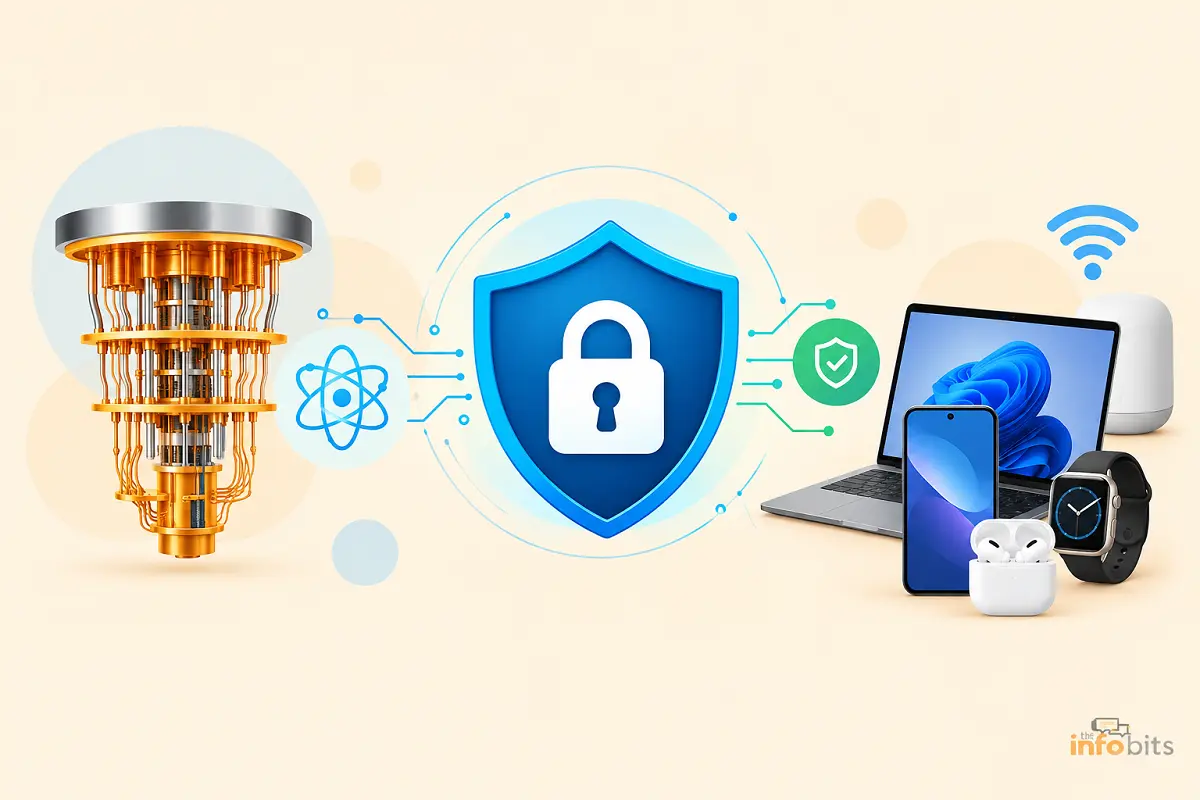
Post-quantum cryptography (PQC) is a new set of encryption methods, built on entirely different math problems that quantum computers aren’t known to be good at solving. The goal isn’t to make encryption “stronger” in the way a longer password is stronger. It’s to switch to a different kind of lock that quantum computers can’t pick, even in principle.
Related: WPA3 Explained: What It Is, How It Works, and Why You Need It
Do Quantum Computers That Can Break Encryption Even Exist Yet?
No, not yet. This is the detail that trips people up, and it’s worth being precise about it. A quantum computer powerful and stable enough to actually break today’s encryption ( sometimes referred to informally as reaching “Q-Day”) doesn’t exist as of this writing.
Estimates for when one might exist vary significantly among experts and researchers, with many projections clustering somewhere in the 2030 to 2035 range, though this remains a genuinely contested estimate rather than a settled date, and some researchers place it earlier or later.
So why is this already showing up in your browser and messaging apps today, years before that threshold? Because of a specific attack strategy that doesn’t require waiting for quantum computers to exist.
The “Harvest Now, Decrypt Later” Problem
This is the real reason PQC matters right now rather than a decade from now. An adversary ( a hostile government, a criminal organization, anyone with the resources) can intercept and store encrypted data traveling across the internet today, even without any way to decrypt it yet.
They simply hold onto it. Then, once a sufficiently powerful quantum computer exists, they go back and decrypt everything they’ve been storing.
For most day-to-day browsing, this isn’t a huge concern. Nobody is likely storing your grocery delivery order for a decade waiting to decrypt it. But for anything with long-term sensitivity, such as government communications, health records, trade secrets, or encrypted messages you’d still care about being private in ten years.
The threat is already active, which is exactly why companies have started rolling out post-quantum protection years ahead of the computers that would exploit the alternative.
Where Post-Quantum Cryptography Is Already Protecting You
This is the part most people don’t realize. You’re likely already using post-quantum-protected connections regularly, without any setting to turn on.
Your Web Browser
Major browsers like Chrome and other Chromium-based browsers, along with Firefox, already default to a “hybrid” encryption approach for many secure website connections. This pairs the traditional encryption method with a post-quantum one (specifically an algorithm called ML-KEM) at the same time.
If a flaw is ever found in one, the connection is still protected by the other. This negotiation happens automatically when you connect to a supporting website. There’s nothing to click or enable.
As of 2026, a majority of encrypted web traffic passing through major infrastructure providers is already using this hybrid post-quantum approach, largely invisibly to users. Safari’s rollout has generally lagged behind Chromium-based browsers and Firefox, with support varying by macOS and iOS version and no dedicated user-facing setting.
Your Messaging Apps
- Signal was among the first large-scale messaging apps to add post-quantum protection, through a protocol called PQXDH.
- Apple’s iMessage introduced its own post-quantum protocol, PQ3, which Apple describes as going further than a one-time upgrade. It periodically re-establishes post-quantum protection throughout an ongoing conversation, not just at the very start.
- WhatsApp has made related advances in key security, though its post-quantum rollout has followed a different technical path than Signal’s or Apple’s.
If you’re using a reasonably current version of any of these apps, this protection is very likely already active for your conversations, without any setting to find or toggle.
Related: Best Password Managers: Tested Picks for Every Need
What’s Not Fully Upgraded Yet
It’s worth being honest about the gaps, since overstating how “done” this is would be misleading:
- Neither Signal nor Apple’s iMessage has yet migrated the authentication part of their protocols (which verifies who you’re actually talking to) to post-quantum algorithms. Only the key exchange piece is upgraded so far. This is a more specialized concern than the harvest-now-decrypt-later issue, but it’s a real, acknowledged gap.
- Enterprise systems, older hardware, and long-lived embedded devices (think industrial equipment, medical devices, and older IoT products) are moving far more slowly than consumer browsers and messaging apps. Surveys of IT and security teams have found a large share reporting that their cryptographic infrastructure isn’t ready for this transition yet.
- A finalized standard for one additional post-quantum signature algorithm (FN-DSA, based on the Falcon algorithm) was still in draft review as of mid-2026, meaning some pieces of the broader post-quantum toolkit are still being finalized.
The Official Standards Behind All This
If you want to understand what’s actually happening under the hood (useful if you ever see these terms mentioned in a settings menu or security advisory), the U.S. National Institute of Standards and Technology (NIST) finalized the first three official post-quantum cryptography standards in August 2024, after a multi-year evaluation process involving cryptography researchers worldwide:
| Standard | Common name | What it’s for |
|---|---|---|
| FIPS 203 | ML-KEM (formerly known as CRYSTALS-Kyber) | Securely establishing a shared encryption key between two parties; the foundation for encrypted connections and messaging |
| FIPS 204 | ML-DSA (formerly CRYSTALS-Dilithium) | Digital signatures; verifying that data or a message genuinely came from who it claims to be |
| FIPS 205 | SLH-DSA (formerly SPHINCS+) | A backup signature method based on different math than ML-DSA, providing a fallback if a weakness is ever found in the primary approach |
NIST later added a fourth algorithm, HQC, specifically to provide additional mathematical diversity for key exchange. If a future breakthrough ever undermines the lattice-based math behind ML-KEM, HQC is built on a completely different mathematical foundation and wouldn’t be affected by the same attack.
NIST has set a target of deprecating older, quantum-vulnerable algorithms entirely by 2035, with regulators and industry groups in various sectors setting their own, sometimes earlier, internal migration deadlines.
Related: How to Use Public WiFi Safely: Real Risks and Smart Habits
How to Check Whether Your Devices Are Already Protected
- Update your browser to the latest version. Most major browsers now handle post-quantum negotiation automatically once updated. There’s no setting to search for.
- Keep your phone’s OS up to date. Post-quantum protections in messaging apps like iMessage are tied to OS and app version, not something you configure separately.
- Check that your messaging app is current. Update Signal, iMessage, or WhatsApp to their latest versions through your app store rather than relying on an old install.
- Don’t expect a visible indicator. Unlike, say, a Wi-Fi security type shown in your network settings, most post-quantum protection negotiates silently in the background. The absence of a visible badge or setting doesn’t mean it’s missing.
- For genuinely sensitive, long-term communications (legal, medical, or business-critical), it’s reasonable to ask a service provider directly whether their encryption includes post-quantum protection, since coverage still varies meaningfully by provider and use case.
Comparison: How Different Platforms Stack Up (as of 2026)
| Platform/Service | Post-quantum status | What this means for you |
|---|---|---|
| Chrome / Chromium-based browsers | Hybrid post-quantum enabled by default | Most secure website connections already protected automatically |
| Firefox | Hybrid post-quantum enabled by default | Same as above |
| Safari | Rolling out more slowly, inconsistent by OS version | Coverage depends on your specific macOS/iOS version |
| iMessage | PQ3 protocol active for supported devices | Automatic for current-generation devices and OS versions |
| Signal | PQXDH protocol active | Automatic for updated app versions |
| Partial rollout via different technical approach | Improving, but on a different timeline than Signal/iMessage | |
| Enterprise/VPN infrastructure | Highly inconsistent, often not yet migrated | Depends heavily on your employer or service provider’s own roadmap |
| Older IoT and embedded devices | Largely not yet addressed | Long replacement cycles mean these lag years behind consumer software |
Related: Can a VPN Secure Your Home WiFi? What It Protects (and What It Doesn’t)
Common Mistakes and Misunderstandings to Avoid
- Panicking that your current data is instantly at risk. The threat here is specifically future decryption of data intercepted now, not an active, immediate break of today’s encryption; quantum computers capable of that don’t exist yet.
- Assuming you need to buy something. Post-quantum protection for everyday use rolls out through normal software updates, not a purchase. Be skeptical of any product marketed specifically as “quantum-proof” hardware aimed at consumers. This is a growing space for overstated claims.
- Thinking this is entirely solved already. Authentication (verifying identity, not just encrypting content) and large swaths of enterprise and embedded-device infrastructure are still mid-migration, not finished.
- Confusing “quantum computing” broadly with “a threat to your encryption.” Quantum computers have many potential applications in medicine, materials science, and other fields entirely unrelated to breaking encryption. The cryptography concern is a specific, narrow slice of the broader quantum computing conversation.
- Ignoring software updates because “nothing looks different.” Since this protection is largely invisible, it’s easy to assume updates don’t matter here. In practice, staying current is the single most relevant action available to an everyday user.
Myth vs. Fact
Myth: “Quantum computers can already break my encryption today.” Fact: No cryptographically relevant quantum computer ( one capable of breaking today’s standard encryption) is known to exist yet. Estimates for when one might range across the next decade or so, and remain genuinely uncertain.
Myth: “If quantum computers aren’t a threat yet, there’s no reason to upgrade now.” Fact: Data intercepted and stored today can potentially be decrypted once quantum computers do mature, which is exactly why “harvest now, decrypt later” makes early migration meaningful even before the threat is fully realized.
Myth: “This only matters for governments and big corporations.” Fact: While the most acute risk applies to long-term sensitive data (government, healthcare, financial systems), the migration is happening at the consumer level too. Your browser and messaging apps are already part of it, generally without you needing to do anything.
Myth: “I need to buy a ‘quantum-safe’ device or app to be protected.” Fact: For the vast majority of everyday use, protection arrives through ordinary software updates to tools you already use, not a new purchase.
Related: Malwarebytes vs Kaspersky: Is Kaspersky Even Legal?
Expert Tips
- If you work in a field handling genuinely long-lived sensitive data (legal, healthcare, government-adjacent, or intellectual property with a decade-plus shelf life), it’s worth asking your organization’s IT team directly where post-quantum migration currently stands. This is one of the areas where “probably fine” isn’t a substitute for a real answer.
- Don’t let “post-quantum” branding alone be a purchasing signal. Ask specifically which NIST-standardized algorithm (ML-KEM, ML-DSA, or SLH-DSA) a product actually implements, since the term itself has started appearing in marketing without much substance behind it in some cases.
- Treat this the same way you’d treat any other background software security upgrade: keep things updated, and don’t let the unfamiliar terminology make it feel like something requiring active management on your part; for nearly everyone, it isn’t.
Final Thoughts
Post-quantum cryptography may sound like something from a science-fiction movie. But its impact on everyday technology is becoming very real.
The good news is that most people do not need to become encryption experts or buy new “quantum-safe” devices. Post-quantum security is increasingly being added quietly through normal software updates. Your web browser, phone, and messaging apps may already be using some form of post-quantum protection without requiring you to change a single setting.
The biggest thing you can do is also the simplest. Keep your devices updated. Install browser updates. Keep your operating system up to date. Update the apps you use for messaging and other sensitive activities.
The reason this matters today is not that quantum computers can suddenly break your passwords tomorrow. They cannot. The bigger concern is protecting information that could remain sensitive for many years. That is where post-quantum cryptography and the move toward quantum-resistant encryption become important.
There is still work ahead. Older devices, enterprise systems, and other long-lived technology may take years to catch up. But the transition has already started.
For everyday users, there is no reason to panic. Think of post-quantum cryptography as the next major security upgrade happening in the background. Stay updated, use strong passwords, and follow good online security habits. For most of us, that is enough to stay prepared while the technology behind the scenes continues to evolve.
Frequently Asked Questions
What is post-quantum cryptography in simple terms?
It’s a new generation of encryption built on math problems that quantum computers aren’t known to solve quickly, designed to replace today’s encryption before quantum computers become powerful enough to break it.
Do I need to do anything to get post-quantum protection?
For most people, no. It’s rolling out automatically through browser and app updates. The most useful action is simply keeping your software current rather than configuring anything manually.
Are quantum computers already breaking encryption?
No. A quantum computer capable of breaking today’s standard encryption doesn’t exist yet. Estimates for when one might range across the next several years to roughly a decade, and remain uncertain.
What does “harvest now, decrypt later” mean?
It describes an attacker intercepting and storing encrypted data today, intending to decrypt it later once sufficiently powerful quantum computers exist. It’s the main reason post-quantum protection matters before quantum computers actually pose an active threat.
Does post-quantum cryptography already protect my online banking?
It depends on your bank’s specific infrastructure and browser support. Many major websites already use hybrid post-quantum connections by default when accessed through an updated browser, but coverage isn’t universal across every financial institution yet.
Does using Signal or iMessage mean my messages are already quantum-safe?
For the encryption of message content itself, largely yes, on updated versions of these apps. Full protection, including the identity-verification portion of these protocols, is still an ongoing area of development even for these leading messaging platforms.
What are ML-KEM, ML-DSA, and SLH-DSA?
These are the official names for the first three NIST-standardized post-quantum cryptography algorithms: ML-KEM for securely exchanging encryption keys, and ML-DSA and SLH-DSA for digital signatures that verify authenticity, each built on different underlying math for extra resilience.
Why did NIST pick more than one algorithm instead of just one?
Algorithm diversity is a deliberate safeguard. If a future mathematical breakthrough weakens one approach (for example, the lattice-based math behind ML-KEM), having an alternative built on entirely different math (like HQC) means the whole system doesn’t fail at once.
Is post-quantum cryptography the same as quantum encryption?
No, and this is a common point of confusion. Post-quantum cryptography runs on regular, classical computers and is designed to resist quantum attacks. “Quantum encryption” (or quantum key distribution) is a different, much less widely deployed technology that uses quantum physics directly as part of the encryption process itself.
Should I be worried about my past encrypted communications being decrypted someday?
For most everyday communications, the practical risk is low, since the effort required to specifically target and store your data is significant and generally reserved for higher-value targets. For genuinely sensitive, long-lived information, it’s a reasonable factor to be aware of, though not typically an actionable one for an individual beyond keeping your tools updated.
How long until quantum computers can actually break current encryption?
There’s no settled consensus. Various projections cluster in the 2030 to 2035 range, though this remains a genuinely disputed estimate among experts, and it’s reasonable to treat any specific year you see cited with some skepticism.
Do I need to change my passwords because of quantum computing?
Not specifically because of quantum computing. Standard password hygiene ( unique, strong passwords managed through a password manager) remains the more immediately relevant security practice for individuals.
Will my older phone or computer still work once post-quantum cryptography becomes standard?
For most consumer devices receiving regular software updates, yes. The transition happens through normal updates. Devices that are no longer receiving software updates at all are the ones at genuine risk of being left behind, which is one more reason ongoing device support matters over time.
Is post-quantum cryptography only relevant to tech and security professionals?
No. While professionals in security-sensitive fields need to actively manage this transition, everyday users are already benefiting from it passively through routine software updates to browsers and messaging apps.
Where can I learn more about the official standards?
NIST maintains the authoritative reference for its post-quantum cryptography standardization project, including the current status of each finalized and draft algorithm, for anyone wanting to go beyond a general overview.
Found this guide useful? Share it with someone interested in new and emerging technologies. Follow us on Facebook and Twitter for more tips, tricks, and guides.
We also ask that you bookmark this page for future reference, as we are constantly updating our articles with new information.
Sign up for our free newsletter as well to receive fresh information immediately in your inbox and keep technically up to date.
Disclosure: If you follow our links to a retailer’s website and make a purchase, we will get an affiliate commission on some, but not all, of the items or services we promote. This will cause no price change for you.
You May Be Interested in Reading:
- Port Forwarding Explained | Setup Guide for Gaming, Remote Work & Servers
- Constant Bitrate (CBR) vs Variable Bitrate (VBR): What’s the Difference?
- What Is Transcoding? A Complete Guide to How It Works and Why It Matters
- MP4 vs MKV: Which Video Format Should You Actually Use?
- MBR or GPT for SSD? The Real Answer (Windows 11, NVMe & 2TB+ Drives)