
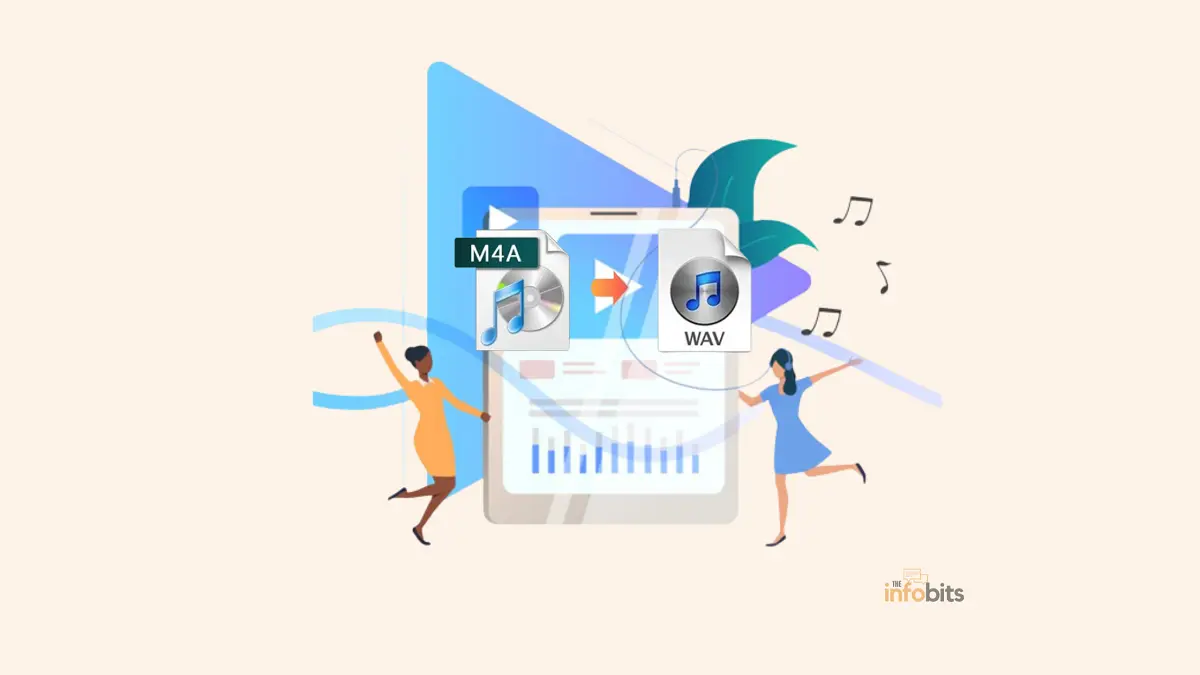
How to Convert M4A to WAV: 5 Free & Paid Methods (2026)
Converting M4A to WAV is usually a two-minute job, but there’s one thing almost every guide on this topic leaves out: converting to WAV doesn’t improve your audio quality.
If your M4A was recorded or downloaded using lossy AAC compression, the WAV file you get out the other end will be larger, sometimes ten times larger, but it won’t sound any better. Knowing this upfront saves you from wasted disk space and false expectations.
This guide covers five practical ways to convert M4A to WAV on Windows, Mac, and in the browser, plus the quality details, batch-conversion tips, and troubleshooting that most tutorials skip.
Quick Answer:
The fastest free method for most people is VLC Media Player (already installed on many computers) or a browser-based tool like CloudConvert for one-off conversions. For batch conversion of many files at once, FFmpeg (command line, free) or a paid converter like WonderFox HD Video Converter Factory Pro is faster and more reliable. Mac users get a built-in option through QuickTime Player or the Music app. Whichever method you choose, remember: WAV output quality is capped by your original M4A’s quality; conversion can’t add detail that compression already removed.
Why Convert M4A to WAV in the First Place?
M4A files typically use AAC (lossy) or occasionally ALAC (lossless) compression inside an MPEG-4 container. WAV is Microsoft and IBM’s uncompressed PCM audio format, the same type of raw audio data used on audio CDs.
Related: How to Convert CD to MP3: Free Methods for Windows & Mac
People convert M4A to WAV for a few specific reasons:
- Audio editing software compatibility. Most digital audio workstations (Audacity, Adobe Audition, Pro Tools, Logic Pro, FL Studio) work best with uncompressed WAV, since compressed formats can introduce artifacts during heavy editing or repeated processing.
- Universal playback. WAV is natively supported by nearly every media player, editing tool, and operating system, including older software that may not recognize M4A.
- Archival purposes. Some people prefer WAV for long-term storage since it’s an open, uncompressed standard not tied to Apple’s ecosystem.
- Video editing and production workflows. Many video editors and broadcast tools expect uncompressed audio tracks.
If you’re just listening to music and don’t need any of the above, there’s usually no benefit to converting. M4A already sounds excellent for everyday listening and takes up far less space.
M4A vs. WAV at a Glance
| M4A | WAV | |
|---|---|---|
| Compression | Lossy (AAC) or lossless (ALAC) | Uncompressed (PCM) |
| Typical file size (3-min song) | 3–6 MB | 30–50 MB |
| Best for | Every day listening, storage, streaming | Editing, mixing, archiving, production |
| Native support | Apple ecosystem, VLC, most modern apps | Nearly universal, including older/pro software |
| Quality after conversion | – | Equal to the source M4A, never better |
Related: MP3 vs MP4: What’s the Difference and Which Format Should You Use?
Method 1: Convert M4A to WAV Online (Free, No Install)
Best for a quick, one-off conversion when you don’t want to install anything.
Step 1: Go to a browser-based converter such as CloudConvert, FreeConvert, or Convertio.
Step 2: Upload your M4A file (drag and drop or click to browse).
Step 3: Select WAV as the output format. Some tools let you adjust sample rate and bit depth under “Advanced Settings”. Leave these at the default unless you have a specific reason to change them.
Step 4: Click Convert, then download the finished WAV file.
A privacy note: Online converters upload your file to a third-party server. This is fine for music you already own, but avoid it for sensitive recordings, voice memos, interviews, or confidential audio, since you’re handing that file to a service you don’t control. Use a local tool (Methods 2–4 below) for anything private. Also note that most free online converters cap daily conversions or file size (commonly 1GB or 1–2 free conversions per day), so they’re not ideal for large batches.
Method 2: Convert M4A to WAV with VLC (Free, Windows/Mac/Linux)
VLC Media Player quietly doubles as a capable format converter, and since many people already have it installed, it’s often the fastest free route.
Step 1: Open VLC and click Media in the top menu, then select Convert/Save.
Step 2: Click Add and select your M4A file(s). VLC supports adding multiple files here for a basic batch job.
Step 3: Click Convert/Save, then under Profile, choose WAV (or create a custom profile if WAV isn’t listed by default).
Step 4: Click Browse to choose a destination folder and confirm the filename ends in .wav.
Step 5: Click Start to begin the conversion.
VLC’s conversion menu isn’t obvious if you’ve never used it before, but once you’ve done it once, it’s genuinely quick for future conversions.
Method 3: Convert M4A to WAV on Mac (Built-In, No Install)
Mac users have three no-download options, ranked from simplest to most powerful.
Option A – QuickTime Player (best for one file):
- Open the M4A file in QuickTime Player (usually the default).
- Click File > Export As > Audio Only.
- Choose WAV as the format and save.
Option B – Music app / iTunes (best for converting your library):
- Open Music (or iTunes), go to Settings > Files > Import Settings.
- Set the import encoder to WAV Encoder.
- Select the M4A track(s) in your library, right-click, and choose Convert > Create WAV Version.
Option C – Terminal with afconvert (best for scripting/batch, zero install): macOS ships with a built-in command-line converter called afconvert. Open Terminal and run:
afconvert -f WAVE -d LEI16@44100 -c 2 input.m4a output.wav
This converts a 16-bit, 44.1kHz stereo WAV ; CD-quality settings suitable for most purposes. To batch-convert an entire folder, wrap the command in a loop:
for i in *.m4a; do afconvert -f WAVE -d LEI16@44100 -c 2 "$i" "${i%.m4a}.wav"; done
This is the fastest way to convert dozens of files at once on a Mac without installing anything extra.
Method 4: Convert M4A to WAV with FFmpeg (Free, Windows/Mac/Linux, Best for Batch)
FFmpeg is a free, open-source command-line tool and the closest thing to an industry standard for format conversion. It has a steeper learning curve than the other free options, but it is unmatched for speed, batch jobs, and precise control over output settings.
Step 1: Download and install FFmpeg from the official site (search “ffmpeg download” for your OS, or install via a package manager like winget, brew, or apt).
Step 2: Open Command Prompt (Windows) or Terminal (Mac/Linux) and navigate to the folder containing your M4A file.
Step 3: Run:
ffmpeg -i input.m4a output.wav
For batch conversion of every M4A file in a folder (Mac/Linux):
for f in *.m4a; do ffmpeg -i "$f" "${f%.m4a}.wav"; done
On Windows (Command Prompt):
for %f in (*.m4a) do ffmpeg -i "%f" "%~nf.wav"
FFmpeg also lets you specify exact sample rate and bit depth if needed, for example ffmpeg -i input.m4a -ar 44100 -sample_fmt s16 output.wav for CD-standard output.
Note: Audacity, a popular free audio editor, can also export M4A to WAV, but it requires installing the FFmpeg library separately to even read M4A files, and its interface is notoriously unfriendly for a first-time user doing a simple conversion.
If you’re already comfortable in Audacity for editing, it’s a reasonable option; if you just need a quick conversion, the methods above are faster.
Method 5: Paid Desktop Converters (Best for Non-Technical Batch Users)
If the command line isn’t for you but you regularly need to convert large batches of files, a paid desktop converter trades a small cost for a friendlier interface and extra features like audio extraction from video, built-in editing, and format presets.
Popular options include WonderFox HD Video Converter Factory Pro, Movavi Video Converter, and Tipard Video Converter Ultimate. All support drag-and-drop batch conversion, retain metadata, and typically process files faster than free alternatives thanks to hardware-accelerated encoding.
General steps (similar across most paid converters):
- Install the converter and open it.
- Drag and drop your M4A file(s) into the interface. Most support unlimited batch conversion.
- Select WAV from the output/audio format menu.
- Click Convert or Run to start.
These tools are worth it if you convert audio regularly and want speed and convenience; they’re overkill for a single occasional file.
Related: Best Free Audio Converter Software Programs
Will Converting M4A to WAV Improve the Sound Quality?
No, and this is the single most misunderstood part of this whole process. If your M4A file was encoded with lossy AAC (the vast majority are), the compression already discarded some audio data permanently when the file was created.
Converting to WAV simply unpacks what’s left into an uncompressed container; it cannot restore data that was already thrown away. The resulting WAV will sound identical to the M4A, but it will take up far more storage space.
The one exception: if your M4A uses ALAC (Apple Lossless), which some Apple Music downloads and GarageBand exports use, converting to WAV preserves full lossless quality since no data was lost in the first place.
Practical takeaway: convert to WAV because you need compatibility with editing software or archival stability, not because you’re expecting better sound.
How Much Bigger Will the WAV File Be?
Uncompressed WAV files are typically 8–10x larger than their M4A counterparts. A 4 MB M4A track can become 40 MB or more as a WAV file.
If you’re converting a large library, do the math on available storage first. Converting 500 songs from M4A to WAV could turn a 2 GB folder into 20 GB or more.
Related: How to Convert CDs to Digital Files: 6 Easy Ripping Methods
Common Mistakes and Troubleshooting
- Expecting better sound quality. As covered above, this doesn’t happen with lossy source files. It’s the most common misconception.
- Running out of storage mid-batch. WAV’s large file size catches people off guard during bulk conversions. Check available disk space before converting big folders.
- Losing metadata (song title, artist, album art). WAV has much more limited metadata support than M4A. If you need to preserve tags, check whether your chosen tool retains them, or keep the original M4A alongside the WAV.
- VLC’s WAV profile isn’t visible by default. If WAV doesn’t appear in VLC’s profile list, click the small wrench/gear icon next to “Profile” to create or edit a custom profile and add WAV manually.
- Audacity won’t open M4A files at all. This means the FFmpeg library isn’t installed. Go to Edit > Preferences > Libraries and download it from within Audacity, or use one of the other methods instead.
Which Method Should You Use?
| Method | Cost | Best For | Batch Support |
|---|---|---|---|
| Online converter | Free (limited) | One-off conversions, no install wanted | Limited (daily caps) |
| VLC | Free | Users who already have VLC installed | Basic |
| QuickTime/Music app/afconvert (Mac) | Free | Mac users, no install needed | afconvert: yes |
| FFmpeg | Free | Power users, large batches, precise control | Excellent |
| Paid desktop software | $30–$50 (one-time or subscription) | Frequent converters who want a GUI | Excellent |
If you only need to convert one or two files, an online tool or VLC is the least friction.
If you’re processing a whole folder of recordings, voice memos, podcast episodes, or an old music library, FFmpeg (free) or a paid converter will save considerably more time.
Since WAV files run 8–10x larger than the M4A originals, anyone converting a large library should budget extra storage. A portable external SSD like Samsung T7 Portable SSD (view on Amazon) is an inexpensive way to keep converted WAV files off your main drive without slowing down transfers.
Related: 10 Best Free Audio Converter Software Programs
Conclusion
Converting M4A to WAV takes a couple of minutes with the right tool, whether that’s a browser-based converter for a single file, VLC, or your Mac’s built-in options for convenience, or FFmpeg and paid software for batch jobs.
The part worth remembering is that WAV won’t sound better than your source M4A. It’s about compatibility and editing flexibility, not quality improvement.
Pick the method that matches how many files you’re converting and how comfortable you are with a command line, and you’ll have clean, editable WAV files in minutes.
Frequently Asked Questions
Does converting M4A to WAV improve audio quality?
No. If the M4A was encoded with lossy AAC compression, the quality ceiling was set at that point. Converting to WAV just uncompresses what remains. It can’t restore data that compression has already discarded.
Is WAV always better quality than M4A?
Not necessarily in terms of sound, only in terms of format flexibility. WAV is uncompressed and ideal for editing, but if the M4A source was lossy, both files will sound the same; the WAV will just be much larger.
Why is my converted WAV file so much bigger than the original M4A?
WAV is uncompressed, while M4A uses AAC or ALAC compression. WAV files are typically 8–10 times larger than the equivalent M4A.
What’s the fastest free way to convert M4A to WAV?
For a single file, an online converter or VLC is fastest. For batch conversion of many files at once, FFmpeg or, on Mac, the built-in afconvert command are faster and more reliable.
Can I convert M4A to WAV without installing any software?
Yes. Use a browser-based converter like CloudConvert or FreeConvert, or on Mac, QuickTime Player and the Music app work with no additional installs.
Is it safe to use online M4A to WAV converters?
For music you already own, yes. For private recordings such as voice memos or interviews, it’s safer to use a local tool (VLC, FFmpeg, or a Mac’s built-in options) since online converters require uploading your file to a third-party server.
Does VLC support batch conversion of M4A to WAV?
Yes, to a limited degree. You can add multiple files in the Convert/Save window, though dedicated batch tools like FFmpeg or paid converters handle large batches more efficiently.
How do I convert M4A to WAV on Windows without third-party software?
Windows doesn’t have a truly native M4A-to-WAV converter. Windows Media Player can technically do it only via burning to a CD and re-ripping, which is impractical. FFmpeg (free) or VLC are the most reliable no-cost options on Windows.
What is the afconvert command for converting M4A to WAV on Mac?
afconvert -f WAVE -d LEI16@44100 -c 2 input.m4a output.wav produces a CD-quality 16-bit, 44.1kHz stereo WAV file directly in Terminal, with no extra software needed.
Will converting M4A to WAV fix compatibility issues with old software?
Usually, yes. WAV is one of the most universally supported audio formats, including in older or professional software that may not recognize M4A.
Does converting M4A to WAV keep the song’s metadata (title, artist, album art)?
Often not fully. WAV has much more limited metadata support than M4A. If tags matter to you, verify your tool preserves them, or keep the original M4A file as a backup.
Can I convert M4A to WAV on my iPhone or Android without a computer?
Most reliable conversions happen on desktop tools or browser-based converters accessed through your phone’s browser, since dedicated mobile conversion apps are less consistent in quality and often ad-heavy.
What sample rate and bit depth should I use when converting to WAV?
For most purposes, CD-quality 16-bit/44.1kHz is more than sufficient and matches the quality ceiling of a typical AAC-encoded M4A. Only use higher settings like 24-bit/96kHz if your source audio was originally recorded at that resolution.
Is FFmpeg better than VLC for converting M4A to WAV?
FFmpeg offers more precise control and is significantly faster for batch jobs, but has a steeper learning curve. VLC is more approachable for occasional single-file conversions if you already have it installed.
Why won’t Audacity open my M4A file?
Audacity needs the FFmpeg library installed separately to read M4A files. Go to Edit > Preferences > Libraries and download it from within the app, or use a different conversion method.
Do paid M4A to WAV converters offer real advantages over free tools?
Mainly convenience and speed for large batches, a friendlier drag-and-drop interface, hardware-accelerated conversion, and extra features like audio extraction from video. For occasional single-file conversions, free tools work just as well.
Can I convert WAV back to M4A later if I need to?
Yes, using the same tools in reverse (VLC, FFmpeg, or Mac’s afconvert with different flags). Note that re-encoding a WAV back to lossy M4A introduces a new round of compression, so keep your original files if quality matters.
Related: How to Convert CDA to MP3: The Ultimate Guide
Please share this article with your friends and relatives if you find it useful.
We also ask that you bookmark this page for future reference, as we are constantly updating our articles with new information.
Sign up for our free newsletter as well to receive fresh information immediately in your inbox and keep technically up to date.
Disclosure: If you follow our links to a retailer’s website and make a purchase, we will get an affiliate commission on some, but not all, of the items or services we promote. This will cause no price change for you.
)