FAST vs. SVOD: Which Streaming Model Should You Use?
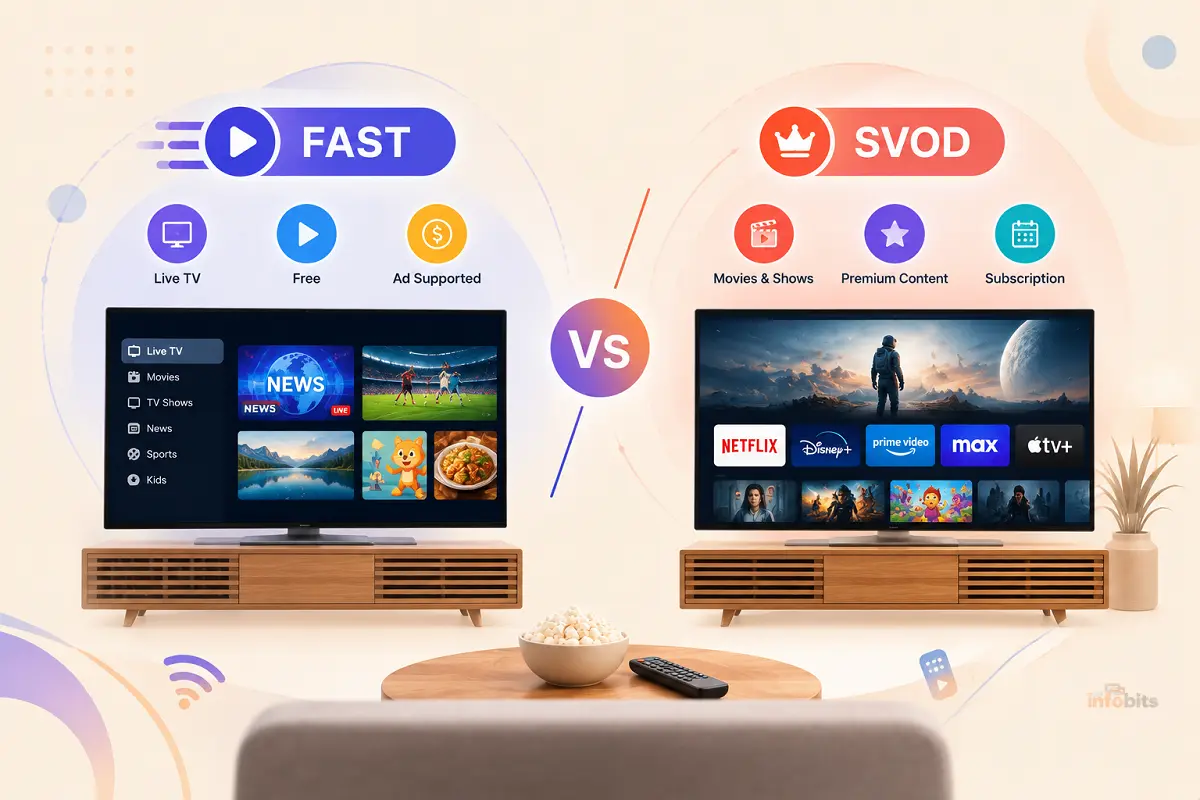
Quick Answer: SVOD (Subscription Video on Demand) is the model behind Netflix, Disney+, and Max. You pay a recurring fee for an ad-free (or ad-light) on-demand library and pick exactly what you want to watch. FAST (Free Ad-Supported Streaming TV) is the free alternative. No payment at all, but instead of browsing a library, you tune into pre-scheduled channels, like Pluto TV or Tubi, and watch whatever’s currently playing, interrupted by ads, much like traditional cable.
Neither one is objectively “better”. They solve different problems. SVOD wins when you have something specific in mind and don’t want ads interrupting it. FAST wins when you just want something on and don’t want to pay or decide.
Most households today end up using a mix of both rather than picking one exclusively, and understanding the actual positives and negatives helps you build a smarter combination instead of paying for subscriptions you barely use.
What Is SVOD?
SVOD stands for Subscription Video on Demand. You pay a recurring fee, typically monthly or annually, for access to a content library, and in exchange you get to choose exactly what to watch, when to watch it, and (on most services) an ad-free or minimally-ad-supported experience.
Defining characteristics:
- Recurring payment, usually $5–$20+ per month depending on the service and tier
- On-demand control – search, browse, pause, rewind, and binge at your own pace
- Deep, curated libraries, often including exclusive originals unavailable anywhere else
- Ad-free or ad-light, depending on which pricing tier you choose
Popular SVOD services include Netflix, Disney+, Max, Apple TV+, and Paramount+. Each is built around a library of movies and shows plus original productions exclusive to that platform.
What Is FAST?
FAST stands for Free Ad-Supported Streaming Television. It replicates the traditional cable-TV experience ( scheduled channels playing continuously ) but delivered for free over the internet, funded entirely by the ads inserted into the stream.
Defining characteristics:
- No cost at all – no account payment, no subscription
- Linear, scheduled viewing – you tune into a channel already in progress rather than picking a specific title
- Channel-based browsing instead of search-driven discovery. Flip between a true-crime channel, a classic-sitcom channel, a 24-hour news channel, and so on.
- Funded by ads inserted into the stream, similar to traditional broadcast TV
Popular FAST platforms include Pluto TV (Paramount), Tubi (Fox), The Roku Channel, Samsung TV Plus, and Xumo Play (Comcast). Most offer hundreds of themed, always-running channels. If you want a deeper look at how FAST actually works day-to-day, our guide on what FAST channels are covers that in more detail.
FAST vs. SVOD: The Core Differences
| SVOD | FAST | |
|---|---|---|
| Cost | Recurring subscription fee | Completely free |
| Viewing style | On-demand; you choose the title | Linear; you tune into a scheduled channel |
| Ads | Minimal to none (varies by tier) | Yes, throughout, similar to broadcast TV |
| Content control | Full; pause, rewind, browse, search | Limited; you’re watching what’s currently airing |
| Content library | Deep catalogs plus exclusive originals | Broad but shallower; licensed and library content, fewer originals |
| Best for | When you know what you want to watch | When you want something on without deciding |
| Examples | Netflix, Disney+, Max, Apple TV+ | Pluto TV, Tubi, The Roku Channel, Samsung TV Plus |
This is genuinely the core tradeoff: SVOD sells you control and exclusivity; FAST sells you convenience and zero cost. Everything else about the two models follows from that basic split.
Related: Apple TV vs Roku: Which Streaming Device Actually Wins?
Cost: The Most Obvious Difference
FAST is free. No account required in many cases, no payment method, no trial period to remember to cancel.
SVOD subscriptions typically run somewhere between $5 and $20+ per month depending on the service and whether you choose an ad-supported or ad-free tier, and that adds up quickly across multiple services.
This is the single biggest driver behind FAST’s growth: subscription fatigue. Many households have found themselves paying for four, five, or more SVOD subscriptions simultaneously, and FAST platforms offer a genuinely free way to fill viewing time without adding another line to a growing monthly bill.
Content Discovery: Browsing vs. Tuning In
SVOD is built around intentional viewing. You open the app already knowing roughly what you want. Continue a show you’re partway through, search for a specific title, or browse curated recommendations tailored to your taste.
FAST is built around passive viewing. You don’t have a specific title in mind; you open the app, scroll through a grid of channels already in progress, much like flipping through cable, and land on whatever fits the mood.
There’s less control (you can’t pause and rewind a channel the way you can an on-demand title on most FAST platforms, though some are adding limited on-demand sections), but also less decision fatigue.
Neither approach is wrong; they match different moods. Plenty of people use SVOD for a specific show they’re actively following, and FAST for background viewing while doing something else.
For a closer comparison of that passive, background-viewing use case against on-demand ad-supported libraries specifically, see our AVOD vs. FAST breakdown.
Ads: How Intrusive Are They, Really?
FAST ads function essentially like traditional TV commercial breaks: scheduled interruptions throughout the linear stream, since the entire platform is funded by that ad revenue with no paid tier to opt out into.
SVOD ad load depends entirely on which tier you choose. Premium/ad-free tiers on Netflix, Max, and similar services carry no ads at all.
Lower-cost ad-supported SVOD tiers (a genuinely blurry middle ground between “pure SVOD” and AVOD) carry a lighter ad load than FAST. Typically a handful of ad breaks per hour rather than the denser interruption pattern of a true linear channel.
The Hybrid Reality: Most People Use Both
In practice, the “FAST vs. SVOD” framing slightly overstates a binary choice that most viewers don’t actually make. The realistic pattern for most households looks like:
- One or two paid SVOD subscriptions for shows and exclusives they actively follow and don’t want interrupted by ads
- One or more free FAST apps for background viewing, filling downtime, or exploring content without committing to a subscription
Many major media companies now run both models themselves. Paramount owns Pluto TV (FAST) alongside Paramount+ (SVOD); NBCUniversal’s Peacock blends a free ad-supported tier with paid options.
The industry itself has largely moved past treating these as competing, mutually exclusive models and instead treats them as complementary tools for reaching different viewer moods and budgets.
Related: PVOD Streaming: What It Is, What It Costs, and Where to Watch
Which One Should You Actually Use?
- Choose SVOD if: You follow specific shows closely, want an ad-free (or ad-light) experience, care about accessing exclusive originals unavailable elsewhere, and are comfortable with a recurring monthly cost.
- Choose FAST if: You want something on in the background without deciding, don’t want to pay anything, enjoy a more passive “channel surfing” experience, or you’re trying to cut down on subscription costs without losing all your streaming options.
- Realistically, use both: Keep one or two SVOD subscriptions for the specific content you actively care about, and lean on free FAST apps for everything else like background viewing, discovering something new without commitment, or filling time when nothing specific sounds appealing.
Common Misconceptions
“FAST is just a lower-quality version of SVOD.” Not quite. They’re built for different moods, not different quality tiers. FAST trades control and exclusivity for zero cost and a lower-effort viewing experience; it’s not simply a worse version of the same thing.
“You have to pick one model and stick with it.” Most media companies themselves run both models simultaneously, and most viewers naturally end up using a mix rather than committing exclusively to one.
“SVOD ad-supported tiers are basically the same as FAST.” They’re closer than pure ad-free SVOD, but ad-supported SVOD tiers still let you choose specific titles on demand, while FAST is fundamentally a scheduled, linear experience. The on-demand control is the real dividing line, not just the presence of ads.
Frequently Asked Questions
What does SVOD stand for?
Subscription Video on Demand – a streaming model where users pay a recurring fee for on-demand access to a content library.
What does FAST stand for?
Free Ad-Supported Streaming Television – a free streaming model that replicates traditional linear cable-style channels, funded entirely by advertising.
Is FAST the same as AVOD?
No, though they’re often confused. AVOD (Advertising Video on Demand) is free and ad-supported like FAST, but it’s on-demand. You choose a specific title, like YouTube or Tubi’s on-demand library. FAST is scheduled and linear. You tune into a channel already in progress. See our AVOD vs. FAST guide for a full breakdown of that distinction.
Can I watch specific shows on FAST platforms?
Generally, no, in the traditional linear-channel sense. You’re watching whatever a given channel happens to be airing. Many FAST platforms (like Tubi and The Roku Channel) also include a separate on-demand library alongside their linear channels, blurring the line somewhat.
Is SVOD worth it if I already use FAST apps?
It depends on whether there’s specific content like originals, exclusives, or a show you’re actively following that you can only get through a subscription. If FAST’s free, background-viewing style already covers most of your actual watching habits, an SVOD subscription may not add much value.
Do SVOD services ever have ads?
Increasingly, yes; many major SVOD services now offer a lower-cost, ad-supported subscription tier alongside their traditional ad-free plan.
Which is more popular, FAST or SVOD?
SVOD still captures the largest share of subscription revenue and viewing time overall, but FAST has grown rapidly in recent years, driven largely by subscription fatigue and its zero-cost barrier to entry.
Do I need a smart TV or streaming device to access FAST channels?
Most FAST platforms are available as apps on smart TVs, streaming devices (Roku, Fire TV, Apple TV), and mobile devices, and several ( like The Roku Channel and Samsung TV Plus) come pre-installed on compatible hardware.
Can content creators make money on both FAST and SVOD?
Yes; many operators run both models simultaneously, using a free FAST channel to build broad audience reach and a paid SVOD tier to generate deeper, recurring revenue from their most engaged viewers.
Is it cheaper overall to drop SVOD subscriptions entirely and only use FAST?
It can meaningfully reduce your monthly costs, but it comes at the cost of losing on-demand control and access to exclusive original content. It is worth weighing against how much you actually value those specific titles versus general background viewing.
Found this guide useful? Share it with someone who is suffering from networking-related issues. Follow us on Facebook and Twitter for more tips, tricks, and guides.
We also ask that you bookmark this page for future reference, as we are constantly updating our articles with new information.
Sign up for our free newsletter as well to receive fresh information immediately in your inbox and keep technically up to date.
Disclosure: If you follow our links to a retailer’s website and make a purchase, we will get an affiliate commission on some, but not all, of the items or services we promote. This will cause no price change for you.