
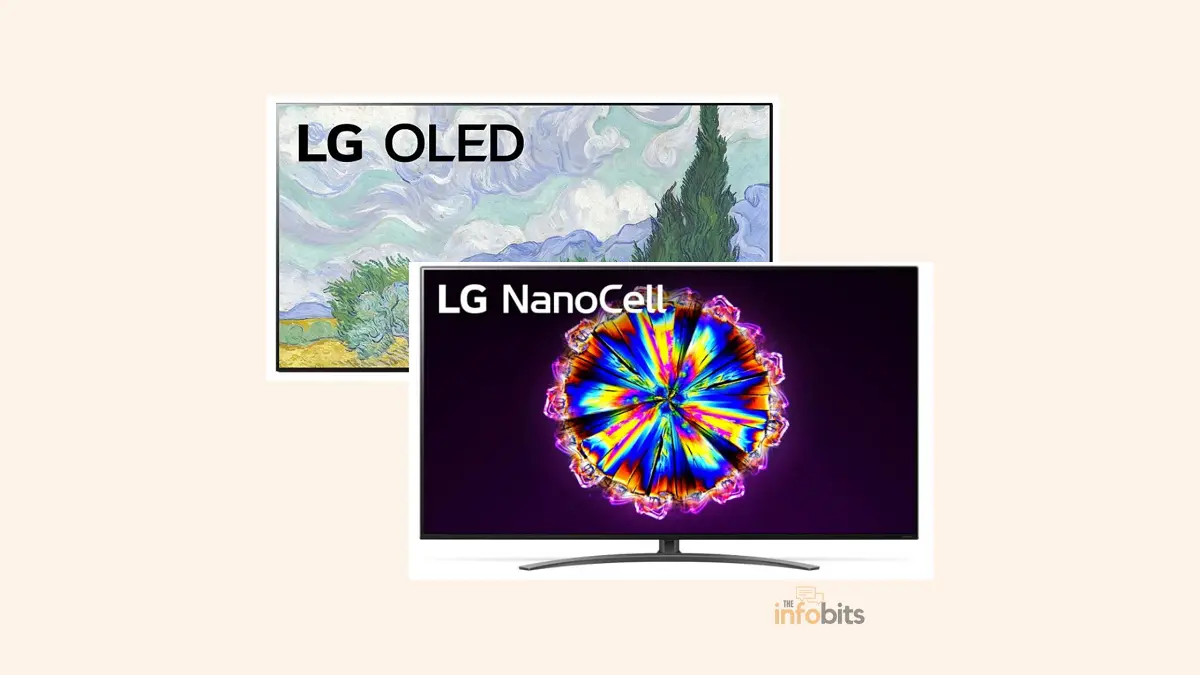
NanoCell vs OLED: Which Is Better? (Plus: What Replaced NanoCell)
If you’re comparing NanoCell and OLED TVs while shopping today, there’s one important update worth knowing before anything else: LG has largely phased out standalone NanoCell TVs.
The technology itself didn’t disappear. Its nanoparticle color filter lives on. But LG folded it into a newer lineup called QNED, which pairs that same filter with Mini-LED backlighting. If you’re shopping LG’s current range, “NanoCell vs OLED” has effectively become “QNED vs OLED.”
This guide explains what NanoCell actually was, what QNED changed, how OLED has evolved (brightness and burn-in both look different than they did even a couple of years ago), and which is the better fit depending on what you actually watch and where you’ll put the TV.
Quick Answer: OLED still wins on picture quality – deeper blacks, better contrast, wider viewing angles, and (as of the newest tandem-panel models) a brightness gap that’s narrower than it used to be.
QNED (NanoCell’s successor) is the better choice on a budget, in a very bright room where peak brightness matters most, or if you want zero burn-in risk with heavy static content like 24/7 news tickers or business dashboards.
If you’re shopping older listings that still say “NanoCell,” treat it as a lower-tier, edge-lit version of what QNED does with Mini-LED; expect noticeably weaker contrast than either QNED or OLED.
What NanoCell Was (and What Replaced It)
NanoCell TVs were LG’s enhanced LED/LCD panels, distinguished by an added layer of nanoparticles acting as a color filter.
That filter absorbed unwanted light wavelengths that would otherwise cause color “bleeding” between adjacent red, green, and blue subpixels, resulting in more accurate color and wider viewing angles than a standard LCD panel, while still being fundamentally a backlit LCD TV underneath.
Starting around 2023, LG began phasing NanoCell out as a standalone line, folding its color-filter technology into QNED (Quantum Nano-emitting Diode), which combines that same nanoparticle filter with Mini-LED backlighting for meaningfully better contrast and local dimming than NanoCell ever offered.
By 2026, NanoCell will be only older carryover stock; LG’s current LCD-based lineup is QNED across the board, positioned as the mid-tier option between basic LED TVs and OLED.
What this means practically: if you’re comparing “NanoCell vs OLED” on a retailer’s site today, you’re most likely actually looking at QNED vs OLED, or an older discounted NanoCell model that a newer QNED will generally outperform for similar money.
Related: IPS vs VA Panel TV: Which Is Actually Best?
What Is OLED?
OLED (Organic Light-Emitting Diode) doesn’t use a backlight; each pixel produces its own light.
That means pixels showing black can switch off completely, producing true “perfect black” and effectively infinite contrast, since there’s no backlight bleeding light into dark areas the way there is on any LCD-based TV (including QNED and older NanoCell models).
Each pixel in an OLED display is controlled independently. This gives OLED TVs excellent viewing angles with consistent picture quality from almost any seat in the room.
OLED panels also offer extremely fast response times, making them a great choice for gaming and fast-moving content. Since they don’t rely on a traditional backlight, they often use less power when displaying a mix of bright and dark scenes.
Brightness: A Narrowing Gap
For years, the standard advice was that OLED couldn’t get bright enough for very sunny rooms, while LCD-based TVs (NanoCell included) had the edge on peak brightness. That gap has narrowed significantly with newer OLED panel designs.
The latest tandem OLED panels use two organic light-emitting layers instead of one. This design allows each layer to operate at a lower voltage while still producing the same, or even higher, brightness.
As a result, modern tandem OLED TVs come much closer to the brightness of premium Mini-LED and QNED TVs. The improved design also generates less heat, which helps reduce long-term panel wear and improves durability.
High-end 2025–2026 OLED models are noticeably brighter than the OLED TVs this comparison would have described just a few years ago. That said, top-tier Mini-LED/QNED sets can still hit higher sustained peak brightness in very bright, sunlit rooms. It’s a narrowed gap, not a fully closed one.
Burn-In: Still Real, But a Smaller Practical Concern in 2026
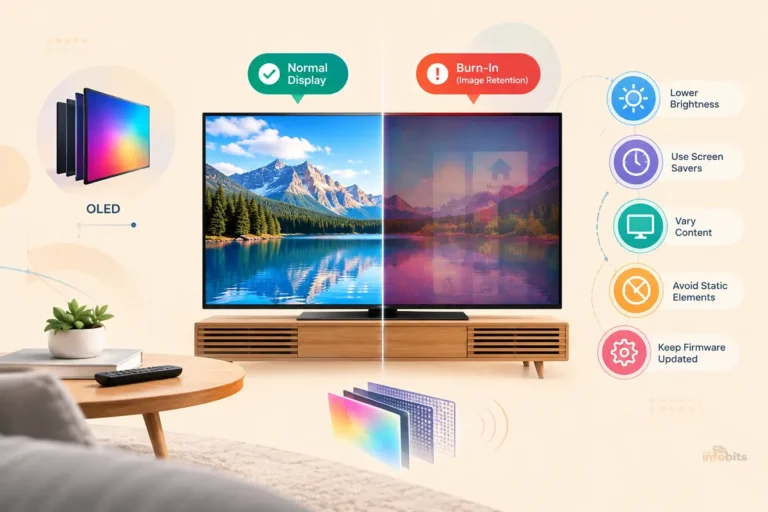
Burn-in, permanent image retention from static content displayed for extended periods, is the classic OLED drawback, and it’s still technically real.
But modern OLED panels ship with multiple active defenses. Automatic pixel shifting that subtly moves the image to prevent uneven wear, automatic dimming of static elements like channel logos, periodic compensation cycles, and (on the newest tandem panels) reduced per-pixel electrical stress that slows organic degradation in the first place.
For typical TV viewing ( movies, streaming, varied sports and shows), burn-in risk on a current-generation OLED is low enough that most manufacturers and independent testers describe it as a non-issue for the average household.
It becomes a more realistic concern specifically for heavy, hours-per-day static content. A 24/7 news channel with a permanent ticker, or using an OLED as a productivity monitor with a static taskbar and toolbars visible for years on end.
QNED and other LCD-based TVs have no equivalent risk at all, which is worth weighing specifically if that describes your actual use case, not as a blanket reason to avoid OLED for normal viewing.
Related: OLED Burn-In Explained: Causes, Real Risk & How to Prevent It
NanoCell/QNED vs. OLED: Side-by-Side
| Feature | QNED (NanoCell’s successor) | OLED |
|---|---|---|
| Panel type | LCD with Mini-LED backlight + nanoparticle color filter | Self-emissive, no backlight |
| Black levels | Good with local dimming, but not true black | True black, per-pixel |
| Contrast | Strong for an LCD, still behind OLED | Effectively infinite |
| Peak brightness | Generally higher in top-tier models | Narrower gap than before; top models are much brighter than older OLEDs |
| Viewing angles | Wide (IPS-based), but color/contrast can shift off-axis | Extremely wide with minimal shift |
| Burn-in risk | None | Low for typical use; a real factor for years of heavy static content |
| Response time/gaming | Good | Excellent, very fast, low input lag |
| Panel thickness | Thicker (backlight required) | Very thin |
| Price | Meaningfully less expensive | Higher, though the gap has narrowed at the low end |
Which Should You Choose?
Choose OLED if: picture quality is your top priority, you watch in a room where you can control lighting (or you’re getting one of the newer, brighter tandem-panel models), you play games and want the fastest response times, or your content mix is varied enough that burn-in realistically isn’t a practical concern.
If you’re planning to buy one, you can explore a wide range of QLED TVs on Amazon and compare features, screen sizes, and prices to find the best model for your needs.
Choose QNED (or a discounted NanoCell carryover) if: budget matters more than best-in-class contrast, your room is very bright with little control over glare and sunlight, or you specifically run heavy static content for years at a time ( signage, a 24/7 news feed, or a dashboard ) where zero burn-in risk outweighs OLED’s contrast advantage.
If you’re considering a new TV, you can browse the latest QNED TVs on Amazon to compare models, features, and prices before making your decision.
For most people buying a primary living-room TV in 2026, OLED remains the better picture-quality choice, and the price gap at reasonable screen sizes has narrowed enough that it’s worth stretching for if the budget allows.
QNED remains a solid, meaningfully cheaper option that still outperforms a basic LED TV, particularly if bright-room performance or static-content use genuinely matters for your situation.
If you’re also deciding between a TV and a computer monitor for a specific room or desk setup, understanding the practical differences between a monitor and a TV is worth reading before you commit to either.
Frequently Asked Questions
Is LG NanoCell still available in 2026?
Only as older carryover stock. LG stopped introducing new NanoCell models starting around 2023 and now sells QNED as its current LCD-based lineup, which uses the same nanoparticle color filter technology paired with Mini-LED backlighting.
What’s the difference between NanoCell and QNED?
They share the same core nanoparticle color-filter technology, but QNED adds Mini-LED backlighting, which gives it meaningfully better local dimming, contrast, and black levels than NanoCell ever had. QNED is best understood as NanoCell’s direct successor rather than a totally separate technology.
Is OLED or QNED better for a bright living room?
QNED (and LCD-based TVs generally) still has an edge in very bright, sunlit rooms, since it can sustain higher peak brightness than most OLED panels. The newest tandem-panel OLEDs have narrowed this gap considerably, but if your room has serious, uncontrollable glare, that’s still a point in QNED’s favor.
Does OLED still have a burn-in problem in 2026?
It’s a much smaller practical concern than it used to be for typical viewing, thanks to pixel shifting, automatic logo dimming, and (on newer tandem panels) reduced electrical stress on the organic material. It remains a real consideration specifically for years of heavy, static content ( a permanent news ticker or productivity-monitor use ) where QNED carries no equivalent risk at all.
Is QLED the same as QNED or NanoCell?
No. QLED is Samsung’s LCD-based technology using quantum dots for color, a different (though conceptually similar) approach to LG’s NanoCell/QNED nanoparticle filter. They’re competing technologies from different manufacturers, not the same thing under different names.
Which is better for gaming, OLED or QNED?
OLED generally has the edge for gaming, with faster response times and typically lower input lag, which shows up most in fast-motion scenes and competitive titles. QNED has closed some of this gap in recent generations but hasn’t matched OLED’s response times.
Is it worth buying a discounted NanoCell TV instead of a new QNED?
Only if the price difference is substantial for your budget. A current QNED model will generally outperform an older NanoCell TV in contrast and local dimming for a similar or only modestly higher price, since QNED is the direct technological successor.
We hope you found this article helpful, and do sign up for our free newsletter to receive fresh information right in your inbox. In addition, we ask that you bookmark this page for future reference.
Also, follow The Infobits on Facebook and X (formerly Twitter) for more PC hardware guides, troubleshooting tutorials, buying advice, and practical tech tips.
Disclosure: If you follow our links to a retailer’s website and make a purchase, we will get an affiliate commission on some, but not all, of the items or services we promote. This will cause no price change for you.

)